Showing posts with label At An Uncertain Hour. Show all posts

Saturday, January 3, 2015

2014 and 2015

Another new year already. Traditionally (by which I mean for the last two years, which seems to qualify as a tradition these days) I start the year by reviewing my writing achievements over the year that's finished and looking ahead to the year to come.

During 2014, my writing has been somewhat disrupted by… well, by writing. Since March, my official day-job has been as a freelance copywriter, and the work I've needed to put into building that up — which seems to be paying off — has severely cut into my creative writing time. Still, among all that, I seem to have got through a fair amount.

I'm not as far as I'd hoped through my current novel (working title The Empire of Nandesh) but I'm more than 50,000 words into it. I'd been hoping to be nearly finished by now, but both the copywriting and other projects have cut into it. I revised the novella The Dweller in the Crack, and wrote three shorter pieces, Finder's Fee, Turning the Tables and Gerda and the Darkness, but the biggest distraction was my very unexpected diversion into children's fantasy.

A few years ago, I wrote a very short piece called The Biggest Dragon in the World, which featured a sorceress called Cariana. I really wrote it for my own amusement, but it turned out as a children's story. During the summer, I attended a workshop of mainly children's authors and took the story along as my one qualifying piece. They loved it and encouraged me to expand it into a series.

I've now written half a dozen other connected stories, but the series took an unexpected turn when, in the second story, I introduced Cariana's nearly-eleven-year-old apprentice Flea, who's taken over as the central character. I'm having huge fun writing about her — in the most recent, she has an encounter with pirates — and the aim is to add perhaps three or four further stories and then, after revision, try to pitch it as a book.

I've begun self-publishing some of my out-of-print work, which has been an interesting process. I have mixed feelings about self-publishing, but it's a valuable option for an author with the experience and willingness to put in the work it needs. So far, I've republished At An Uncertain Hour, the novel previously issued by StoneGarden, and Steal Away, the first story about Karaghr and Failiu, which first appeared in the late, lamented Golden Visions. I'm also hoping to bring out the sequel, Rainy Season, also a Golden Visions story, and perhaps others.

As far as professional publication is concerned, December saw the publication of my second ebook from Musa Publishing, The Lone and Level Sands. A contemporary (or nearly contemporary) fantasy but set in a secondary world, this is archaeological fantasy somewhat in the Indiana Jones tradition. It came out just before Christmas, so I'm gearing up again to restart promotion.

Besides these, I've had stories in The Colored Lens (Damned) and Plasma Frequency (The Lady of the House and The PetrologicEngine, the latter my "flintpunk" story) as well as in three anthologies, two of which I was involved in producing. Light of the Last Day was the somewhat overdue anthology from Fantasy-writers.org, which I co-edited and contributed Lari's People and Dayglow, while the equally long-in-making The Tale Trove is the first production from my live writers' group, the East Herts Fantasy Writers. My contributions are Return Switch, Hanuut's Stand, I See a Voice and three poems. I've also appeared in Unburied Treasure, a follow-up to last year's Trespass, with the custom-written Finder's Fee.

So what of 2015? I'll probably continue to have less time to devote to writing than I did before last year, but I have The Lone and Level Sands to promote, and I hope to reissue Rainy Season this year. On a slightly longer-term basis, I've been considering self-publishing a collection of stories about Eltava. All but two have been published in various markets, and all rights have now reverted to me, so it might be a practical option. But a lot more work than putting out single stories.

I'll continue with both The Empire of Nandesh and the Flea stories, and hopefully I'll finish the draft of the former and have the latter ready for submission during the year. That's assuming I don't get diverted again. We'll see.

I'd like to wish you all a very Happy New Year.

Monday, February 17, 2014

Self-Publishing Old Works

The Blogosphere (or at least that part of it interested in writing and publishing) has lit up recently with debate about the latest "proof" that authors should forget about traditional publishing and embrace the heady fortune that's waiting for them if they self-publish.  I'm not going to discuss the issue at length, but for a sensible, moderate view I'd recommend the posts that Chuck Wendig has made over the past few days on the subject, which debunk the more ridiculous claims while appreciating the possibilities of self-publishing.  The usual disclaimer for Chuck — his arguments are incisive, but his language isn't for those of a strait-laced persuasion.

I've always been very cautious of the self-publishing boom.  Self-publishing is by no means new — Charles Dickens did it, among many others — but it used to be costly and difficult.  What's changed is that it's now fairly easy and (at least in theory) it can be done for free.  This is a good thing, of course, but its very big downside is that authors who used to have to hone their skills through the cycle of submission and rejection now have the power to sling out their first drafts on Kindle, unrevised, unedited, poorly designed and with amateurish covers.

It certainly can be done properly, and most of the much-touted success stories are authors who knew what they were doing (often from experience of traditional publishing) and were willing to put a significant amount of time, effort and (often) money into preparing the book and then promoting it.  These, though, aren't always easy to spot in the midst of an avalanche of poorly prepared work

In spite of my reservations, I've just taken my first plunge into self-publishing by issuing a second edition of my novel At An Uncertain Hour.  This was originally published by the American house StoneGarden, which unfortunately closed down last year due to the owner's need to rearrange the priorities in his life.  I'd like to emphasise that my experiences with StoneGarden were all positive, from submission to their honest handling of the closure and reversion of rights, and I wish Kris all the best.

This was somewhat different from the average self-publication in various ways.  For one thing, this was a book that someone had considered worth investing his own money to publish, and for another I'd been through a rigorous editorial process with StoneGarden (four edits and then the galleys, if I remember rightly).  That didn't stop me giving it another once-over, but it did mean that I didn't feel the need to hire a professional editor.  That would have been beyond my means at the moment, but I'd be very reluctant to put out a "raw" novel without it.

There was still the cover to get right.  I have little confidence in my artistic abilities, but I was lucky to get a design from the excellent A. Carson without the high fee her skills really deserve.

I published the print and EPUB editions through Lulu, and the Kindle version (obviously) through Amazon, and it was definitely a steep learning curve.  Especially as I was simultaneously doing the same for the anthology Light of the Last Day.  I learnt about how their systems work, and everything from the assignment of ISBNs to allowance for "bleed" to how to make a table of contents in Word — something I'd never had the need to do before.

There were definitely hair-tearing moments, but I'm delighted by the results, and this made me think.  Ebooks, at least, don't need to be of novel length — I have several ebooks out from various publishing of novelette/short novella length — and many of my stories have been published in magazines or webzines that are no longer available.  The rights have reverted to me, so why shouldn't I make these available again?

The pros and cons are much the same as for At An Uncertain Hour.  Although none of these works have undergone the same intensity of editing, they've been accepted and tidied up by respected editors, and shouldn't require extra professional editing.   And, like the novel, these stories have been deemed good enough for publication.

This leaves the cover, which is going to be the main sticking point.  Maybe I'll be able to get another favour, or perhaps my finances will improve to the extent that I can afford professional rates.  Or, perhaps, I can overcome my doubts and try to do it myself — though I'll certainly ask for feedback from people who'll be honest with me before I use any of my own efforts.

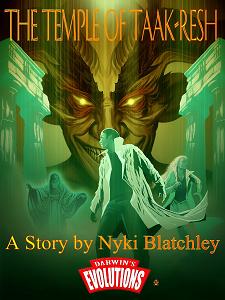
I have a list of suitable stories, but for now there are three priorities.  The City of Ferrid, a fantasy thriller set in an industrial revolution society (though not really steampunk) was published as both a chapbook and an ebook by Crystal Codices, a publisher sadly no longer with us.  Steal Away and Rainy Season were both published in the webzine Golden Visions, also now defunct.  I'm particularly eager to get these back into print, since they're the first two stories in my series about the... shall we say enthusiastic teenage sorcerers Karaghr and Failiu.  The third story, The Temple of Taak-Resh, is currently available from Darwin's Evolutions, and I should soon be ready to start shopping the novella The Dweller in the Crack to publishers.  It would be good to have the earlier part of the series republished.

Is any of this going to work?  I've no idea, and I don't know if I'm going to be able to get suitable covers, but I think it's worth trying.  If these do turn out successfully, I have more out-of-print stories to come.

Thursday, February 6, 2014

At An Uncertain Hour is back in print


At An Uncertain Hour
by Nyki Blatchley
Cover art & design by A. Carson
Second Edition
 
Editions Available:
 
Print edition £11.99
EPUB edition £2.99
Kindle edition from Amazon.com $3.99


As two armies stand poised for the final battle of a millennium-long war, the immortal, charismatic leader known only as the Traveller reflects on what led him, long ago, to begin this war of liberation. Amid the alarms and encounters of a sleepless night, he thinks back over three thousand years of life: the loves and hates, the victories and disasters, the moral dilemmas - and the lost love he still mourns. As battle is joined, the tale has a few more twists to throw at the Traveller.


"This is an elegant novel, poetically written, with just the right mix of pathos and humour, and the Traveller's ability to mock himself ensures it never spills over into mawkish sentiment...The supporting cast of characters are well-drawn, but the Traveller rightfully dominates the story." - Joanne Hall, hierath.wordpress.com


"The Traveller and the people he's known are all very interesting and the way their stories interlock kept me turning pages until long past bedtime...Blatchley's pacing is good and how he plays different time periods in the Traveller's life as he tells his own story is great." - K. A. Severson on SFReader.com


Wednesday, January 1, 2014

2013 and 2014

2012 was a great year for me as far as publication was concerned, but 2013 seemed to slow down a little.  Even so, there's been a fair amount to celebrate.

Perhaps the biggest thing out was The Triarchy's Emissary, issued by a new South African epublisher, Fox & Raven.  This was a story I wrote several years ago for a shared-world anthology that collapsed before it was complete.  We created the world between us, and I've always been proud of the story I wrote for it, even though no-one was accepting it, so I'm grateful to Marius for putting it out and delighted to be helping Fox & Raven get off the ground.  Coincidentally, another contributor to the anthology also had an acceptance for her anthology story at around the same time, which was wonderful.

Following the publication of The Treason of Memory (still available) at the end of 2012, Musa Publishing have accepted The Lone and Level Sands, my secondary-world Indiana Jones style story about archaeologists, desert countries and ancient, haunted temples.  I don't have a publication date for it yet, but I look forward to getting to work on it.

Besides The Triarchy's Emissary, I've only had one story newly published this year — River God in the excellent magazine The Colored Lens, a story that combines fantasy with ecology and owes a little in influence to John Boorman's haunting film The Emerald Forest.

I've also had two reprints, though.  A Deed Without a Name, which featured during 2012 in Penumbra's Shakespeare-themed edition, reappeared in The Best of Penumbra Vol. 1, while Just Deserts featured in Leslianne Wilder's anthology Trespass (available from Amazon.co.uk and Amazon.com).  This story about Eltava and the spoilt princess from hell was first published by Quantum Muse in 2007, and I was a little mortified to find they'd published it as "Just Desserts".  Well, there was meant to be a pun along those lines, as it involved cannibals (just like the other pun referring to its setting in a desert) but I'm delighted, among other reasons, that it's now available under the correct title.

On the downside, StoneGarden.net, who published At An Uncertain Hour, have closed down.  Kris always ran it as a one-man-band, and he needed more time for other parts of his life, such as his family.  I wish him all the best, and many thanks for putting the book out.

The positive from this is that all rights have reverted to me, so I'm free to self-publish a new edition.  I have mixed feelings about self-publication — while it's a great option, much of what's put out seems in dire need of professional input — but as At An Uncertain Hour has already been extensively edited by StoneGarden, I see no reason not to go ahead.  I'm hoping it'll be back in print early in the new year.

Away from fiction, Fantasy Faction published my article series this year on The Chaotic Champion, a concept about the nature of heroes in fiction I began as a book in the mid-1990s but lost to a computer crash.  I've finally got around to writing it, although in a much shorter version than the original concept.  Still, it seemed to go down well, so who knows?  I may yet expand it into a book.  Links to all my Fantasy Faction articles can be found on my website.

On the writing front, the big news is that I've finally finished my trilogy The Winter Legend.  Well, apart from all the extensive rewrites, of course, but it still feels incredible to have a complete version of the project I first conceived nearly forty-five years ago.

I've now started on my next novel, with the working title at the moment The Empire of Nandesh, which is both sequel to At An Uncertain Hour and prequel to The Winter Legend.  Just to make it more difficult for myself, I'm writing it in four separate first-persons, with extensive flashbacks in all of them, in the same sort of style as At An Uncertain Hour.  Well, I wouldn't want to get bored, would I?

I only wrote four shorter pieces this year, though one was a novella — The Dweller in the Crack, a story about Karaghr and Failiu, whose tales could be viewed as my most successful series, since all three of the stories so far have been published, including The Temple of Taak-Resh.  This one, currently 26,000 words, still needs to be stretched and hacked into shape on the Procrustean Bed of revision, but I'm looking forward to having it finished.

So, onward to 2014.  As I said, I'm hoping to have At An Uncertain Hour back in print (physical and virtual) early in the year, and I have one outstanding story to come — The Lady of the House in the February/March issue of Plasma Frequency.

The Tryst Flame, the first part of the trilogy, has been to a few agents and will be knocking on the doors of many more in the new year.  The other two parts will need to be pulled into shape at some stage, but my priorities for now are to finish the draft of The Empire of Nandesh and get The Dweller in the Crack in a fit state for submission.  And hopefully there'll be other story ideas waiting to ambush me.

Happy New Year to everyone.  I hope all your projects turn out to be twice as successful as you planned.

Thursday, December 12, 2013

Race in Fantasy: In Memory of Nelson Mandela

Although this is a writing blog, I didn't feel I could ignore the death of one of the great human beings of our time, Nelson Mandela.

I grew up not only in a liberal family but also in the context of the radical strand of the Sixties whose principal concerns were opposing racism and war.  I partly accessed this through music — Bob Dylan was and remains my main musical idol, and I listened to a whole range of socially aware folk and rock musicians — but I followed the news closely too. 

I was well aware of the American civil rights struggle, but in Britain the issue of apartheid in South Africa and Rhodesia was closer to home.  We never bought South African produce at home — such that, even now, I sometimes have to think twice before I remember it's fine to eat South African fruit or drink South African wine.

Another issue that brought apartheid very much to the fore was sport.  I've always been a cricket fan, and the pros and cons of playing against South Africa were hotly debated, especially during the "D'Oliveira affair" of 1968.  Although I've never supported political sniping in sport, I always felt that apartheid was a different issue, since it impacted directly onto the sport itself, and I strongly supported banning contact.

The South African issue remained important to both me and the culture I moved in throughout the Seventies and Eighties, and Nelson Mandela increasingly became the icon and the struggle.  The slogan "Free Nelson Mandela" was everywhere, and the feeling was that he could make everything right.  That's normally a poisoned chalice, since anyone who has that kind of expectations laid on them is usually being set up to fail.  Nelson Mandela succeeded triumphantly.

He didn't do it on his own, of course.  There was a whole movement behind him, and the character of the South African peoples was crucial.  Some credit should also go to de Klerk for doing the right thing, for whatever reasons.  But the fact that South Africa transformed from apartheid to the Rainbow Nation without the expected bloodbath is due in no small part to this extraordinary man.

As I said, this is a blog about writing, and particularly about fantasy, so it seems appropriate to mark this moment by looking at issues of race in fantasy.  Traditionally, the genre hasn't dealt well with non-white ethnic groups.  In the old sword & sorcery tales, for instance, if characters weren't so-called "pure Aryan" (a misnomer based on sheer ignorance) they were either stupid savages, decadent barbarians or comic stereotypes.

On the other hand, speculative fiction has often dealt with racial issues far more subtly and sympathetically by the back door.  Tolkien, for instance, has often been accused of a certain degree of racism, and certainly all the "good" humans are white, while the barbarians from far lands all serve Sauron.  It's also true that he uses a traditional colour symbolism which these days is associated with race, although it's doubtful whether that connection would have commonly been made when Tolkien was writing.

However, although Tolkien no doubt shared a certain amount of the casual racism of his generation, he was anti-racist for his time.  He was born in South Africa, where his parents are recorded as being disgusted by the treatment of Africans in the 1890s, and a rare public comment on the subject in the 1950s made it clear that he firmly opposed apartheid.  He was also fairly unusual for intellectuals of his generation, many of whom were sympathetic to the Nazis, in being implacably opposed to anti-semitism, referring to Hitler's "filthy racial doctrine".

Where Lord of the Rings does express a more liberal attitude is in the relations between his fantasy races.  Whether it be the ancient enmity between elves and dwarves, the mistrust of the Rohirrim for the elves of Lothlorien or everyone's scorn for hobbits, one message the book delivers over and over is that the world can only be saved if all peoples of goodwill work together and find the good in one another, regardless of how strange they seem.

This kind of approach to race relations is often used in both fantasy and science fiction.  In Star Trek, for instance (which does better than some at diversity, even if it does occasionally smell of tokenism) it's the relations between the various aliens — Vulcans, Klingons, Romulans, Cardassians and the rest — which often stand in for racial and ethnic issues.  The original series, which had a habit of portraying its ideas in ways that are glaringly obvious but still oddly effective, dealt with the absurdities of racism in the episode about the half-black-half-white race whose bitter prejudice was based on which half was which.

As far as racial diversity in fantasy goes, though, things have improved a little, but not as much as might be expected.  There are honourable exceptions, of course, such as Ursula LeGuin's Earthsea series, which has a rich racial mix and a main character who in real-world terms would be Native American (a fact blithely ignored by the makers of the disappointing TV version) but such cases are still the exception rather than the rule.

I've tried to show racial diversity in my work, especially since the stories are spread over an entire imaginary world.  In At An Uncertain Hour, for instance, although the central character is white, the majority of characters, many of them his friends or lovers, are a mixture of black, red, brown and yellow.  Eltava, who appears both in the book and in a series of stories of her own, would in real-world terms be half Chinese and half Native American.

On the whole, I haven't used this to explore parallels with our world's racial issues, preferring simply to show a racially diverse world in a broadly positive way — not that it lacks negative aspects of other kinds.  Occasionally, though, I've included issues of racism, such as in At An Uncertain Hour's portrayal of the city-state of Dakh'el.  This is a place where the white population have subjected the black population (whom they charmingly refer to as the unclean) to such a level of slavery and degradation that torturing and killing "unclean" is seen as a sport that everyone participates in.  Besides using this episode as an outlet to express my hatred of racism, it asks the question — unfortunately without being able to supply the answers — of how to overcome such entrenched prejudice and hatred.  Maybe the answer was that they needed a Nelson Mandela, though I don't think even he could have solved that one.

Many people seem to believe that authors should only portray characters of different races when they want to "deal with the issues" of their race.  This kind of argument, which is also put forward for other kinds of characteristics such as LGBT, seems to me to be advocating the worst kind of tokenism.  Any realistically created world is going to be racially diverse, and there seems no reason at all not to express that diversity in stories.  There doesn't need to be a "reason" for a character to be black, any more than a "reason" for them to be white.

A more serious objection is that many writers feel inadequate to write about characters of a different race, fearing that they won't do justice to an experience they haven't shared.  There's something in this as far as real-world settings are concerned, although I wouldn't say it's an impossible task, but I can't see any reason for such an objection in a fantasy world.  There's a big difference between race and culture and, for example, a black person in a world where there's been nothing equivalent to Africa's experiences of the slave trade and aggressive colonisation won't have the same cultural issues that a black person in our world might.

The legacy Nelson Mandela left is a country where, in spite of many problems, the wounds left by the racial divisions of the past seem to be healing.  Fantasy is, among other things, fiction that gives us visions of the best and the worst that a world can be.  I don't believe it has any excuse nowadays not to reflect and celebrate the same multi-racial nature of humanity.

Monday, July 1, 2013

At An Uncertain Hour is now Out of Print

I regret to inform you that StoneGarden.net has closed down, as of today, so At An Uncertain Hour is now out of print.  Kristopher Stamp has done a splendid job with StoneGarden, but he's reached the stage where he needs to move on to other things.  I'd like to thank him for publishing At An Uncertain Hour and for all the help he's given me.

The rights have now reverted to me, and I'm hoping to be able to reissue the novel on Kindle, and maybe even in a print format, as a self-published book.  My main reservation about self-publication is the editorial issue, since the choice is between paying a substantial amount for a freelance editor and issuing a book without a rigorous, professional editorial process.  In this case, however, I have the benefit of StoneGarden's original editing, so I can be confident that this aspect, at least, will be up to scratch.

The self-publishing process will be a learning curve, and I'm not sure how long it's going to take, but watch this space - the Traveller will return.

Saturday, June 1, 2013

Living in a Flexible World

I just signed the contract with Musa Publishing for a second ebook, The Lone and Level Sands, to be issued under their Urania imprint.  This story is set in the same world as my previous Musa publication, The Treason of Memory (as well as many other stories, including my StoneGarden novel At An Uncertain Hour and my Darwin's Evolutions ebook The Temple of Taak-Resh) but in a different type of setting from those.

The two last, like a number of others, are set in what could loosely be called a standard setting for epic fantasy or sword & sorcery.  Hopefully not in a clichéd way — I try to portray a range of different types of pre-gunpowder civilisations, rather than the usual bland blend of something that vaguely passes for a cross between mediaeval Europe and ancient Babylon — but the stories have broadswords, horses, temples to numerous gods and so on.

The Treason of Memory, on the other hand, is set in a culture of flintlocks and rapiers, somewhat reminiscent of Europe in the late 17th/early 18th centuries, while The Lone and Level Sands has more in common with the mid 20th century.  This is a long way from broadswords, or even flintlocks, although perhaps not exactly like the equivalent period in the real world: land vehicles are mainly electric, for instance, and air travel comes courtesy of airships.

The Lone and Level Sands is archaeological fantasy.  Like parts of the Indiana Jones series, it's set in a desert country in an unstable world where anything could happen.  It has elements of a thriller — sinister rivals, trigger-happy soldiers, blackmail and betrayal — as well as the fantasy elements of a temple out of mythology and... well, you'll have to read the story, when it comes out.

Coincidentally, I have another story coming out later this year, in the excellent magazine Aoife's Kiss, which is related to this, to the extent that it's also a view of the same myth from a "modern" world.  This time, though, the culture is the computer age of the same world.  If you pay attention, you'll find a couple of more specific links between the two.

So what's the advantage of doing it this way?  Wouldn't it be simpler to create a world for each story, or at least each series?  A pre-gunpowder world, a world of flintlocks, and so on?  Just invent what I need, when I need it?

Well, it would be easier in some ways, but I think nowhere near as effective.  In a joined-up world, the ideas don't come in isolation, and they don't develop in isolation, either.  The legend behind The Lone and Level Sands is (hopefully) effective because it's a story I already knew, and the "modern" discovery has a history that make it comparable to finding a relic from Atlantis in our world.

The background to these stories isn't just a background — it's people and places whose stories I know and have written about.  That's a level of reality that's difficult to achieve in a one-story world.  Not impossible, but difficult.

The world I use offers me the means to write almost any kind of story I want, from epic fantasy to occult thriller — I've even found a corner to write something resembling steampunk — and stories come into being from the influence of their own past and future.  There are stories coming to me that need to belong to a different world, whether it's a one-off or an ongoing world, but I don't anticipate running out of fascination and inspiration in my flexible world anytime soon.  Probably never.


Friday, May 3, 2013

Heroes & Villains Blog Hop


Welcome to the Heroes & Villains Blog Hop, which will be running on the 3rd, 4th, 5th and 6th.  Various authors of fantasy, science fiction and historical fiction will be giving us their insights on the heroes and villains of their stories, or perhaps those created by authors they admire.  A complete list can be found at the bottom of this article - please visit as many of them as you can.


I'll be giving away a free copy of my fantasy ebook The Treason of Memory, published by Musa Publishing.  To enter the draw, simply follow this blog and then post a comment to let me know you've done so.  After the hop is over, I'll pick a name using the latest high-tech randomising device (the exact design is a trade secret, but it involves slips of paper and a hat) and announce the winner.

For excerpts of the three publications mentioned below, click on the cover images.


Heroes and villains.  Well, that seems simple enough.  In one episode of Buffy the Vampire Slayer, for instance, Giles explains to Buffy that heroes are always stalwart and true, while villains can be easily recognised by their horns or black hats.  But all it not what it seems — this is a response to her plea, "Lie to me," and is conspicuously untrue of the rest of the show.

It's never as straightforward as that, at least not in the more interesting stories.  It's not that some people aren't admirable, trying their best to do the right thing regardless of the cost to themselves, or that other people aren't despicable, selfish and vicious, but people are too complex to pigeonhole into angels and demons.  In any case, the most interesting characters tend to be those who fall awkwardly between the absolutes.

The main character of my novel, At An Uncertain Hour, certainly looks like a hero.  Known only as the Traveller, he wanders the world, helping the oppressed and fighting evil.  On the other hand, he doesn't really want to take up noble causes, just to see the world and enjoy himself, and he frequently resents giving in to his feeling of duty.


He can be mischievous, stubborn and thoughtless; and, as an immortal, he has the potential to be dangerous, too.  In another story in which he appears, he tries to explain his insistence on keeping a promise against reason by saying, If I were to let myself abandon a clear sense of right and wrong, I could be far more dangerous than Kargor [the "villain" of the story].  The lure to abuse his power and immortality is always there.  He's a hero, not because he's simply "stalwart and true", but because he succeeds in fighting temptation.

The main villain in the novel, the Demon Queen of the South, is for much of the story an intangible, distant figure, much like Sauron, but that's not all there is to her.  She's a human being who's been hurt — appallingly — and has chosen to do anything it takes to prevent herself from being hurt again.  This has led her to unspeakable evils, but her reasons have always been very human and make sense to her.

In my novella The Treason of Memory, the situation is less defined.  There are certainly people struggling to uncover and fight an ancient evil, and there are people hoping to gain from that evil, but the heroes aren't especially heroic: a young innocent who remembers the guilt of a terrible crime he probably didn't commit, and a seedy spy who doesn't remember a terrible crime he probably did commit.  The villains (mainly politicians) aren't really what this story's about.  If anything, the theme is that it's always difficult to know who's hero and who's villain.  The point is to try the best you can to do the right thing.

The Temple of Taak-Resh could be said not to have heroes or villains, just people we root for and people we don't.  It's the third of a series of stories (the first two were published by the sadly defunct webzine Golden Visions) about Karaghr and Failiu (Kari and Fai to their friends), young, wandering sorcerers.  Air-headed and irresponsible, they could be described as juvenile delinquents — but, being teenagers, they naturally prefer to think of themselves as a pair of outlaws, together against the world.  They take sides in the story not so much on moral grounds, but according to their personal interests.


Kari, though, has a long and strange life, and these tales are actually his back-story.  He originated as the villain of my trilogy The Winter Legend (referred to above as Kargor).  When I first came up with the story, many years ago, he was simply a traditional Evil Overlord, but I gradually realised that, for many reasons, this didn't work.  He needed to be nice.

That might seem a contradiction in terms, since he was still going to be the villain, but it's been much more interesting to write him that way, and I hope he'll be equally interesting to read.  He still conquers and terrorises the neighbouring countries, but he's not only charming on a personal level, he really cares about his friends and those under his protection.  Forget telling your minions that they're less than worms under your feet — this is an Evil Overlord with genuine people skills.

Like the Demon Queen, Kari took a step that seemed reasonable at the time, and that led to another and another, till he feels now he has no choice but to continue on his course.  Also like the Demon Queen, his main concern is his own safety.  Doing the right thing is all very well, but he always falls back in the end on doing whatever safeguards him.

It would be an exaggeration to say that Kari goes from hero to villain (antihero to villain, perhaps) but I hope he illustrates that, fundamentally, no-one is simply either.  Just a human being, who leads their life better or worse than others.


Heroes & Villains taking part are:


Tuesday, January 1, 2013

2012 and 2013

So, another year over, and a new one just begun.  2012 was a mixed year for me, but mainly good on the writing front.  Early in the year, StoneGarden.net issued an ebook version of my novel At An Uncertain Hour (still also available in paperback as well).  

A lot of good news for my short stories.  Still far more rejections and acceptances, of course, but that's always going to be the case, unless your name happens to be Stephen King or George R. R. Martin.  Quite a few successes, though, with eight stories published.  Of those, three appeared in publications that are rated professional and one that subsequently upgraded to professional, and the year culminated in the publication of my short-story ebook from Musa.

To give full details:

Nemesis: The Case of theHell-Hound in Penumbra June 2012
The Cell in Bards & Sages Quarterly July 2012
Nemesis: The Case of theHeadless Lady in Wily Writers July2012
Aslahkar in Plasma Frequency August/September 2012
Witch in Aoife's Kiss September 2012
The House of Dreams in Lore November 2012
The Treason of Memory from Musa Publishing

Several things were particularly pleasing, including The House of Dreams, which had racked up so many rejections that I almost gave up on it.  I still believed it was a good story, though, and hey presto!  It was accepted at last by a professional magazine.

I was also surprised, as I mentioned in a recent piece, that three out of the eight stories (both Nemesis stories and The Cell) were comedy, something which I'm only gradually coming to believe I can do.  I'm hoping to develop this further.

And I was delighted by the way The Treason of Memory turned out, especially that stunningly atmospheric cover by David Efaw.

My articles on classic fantasy have continued to appear monthly, featuring authors as diverse as Chrétien de Troyes (12th century) to Michael Moorcock (1960s).  Hopefully I've sent a few readers back to the fantasy that was around before the 80s, excellent as many of the newer authors are.

There were other great things related to writing, including Fantasycon, where I had my first, if very minor, experience of being invited as a guest.  This was because, more years ago than I care to remember, I had a story in The Thirteenth Fontana Book of Great Horror Stories, edited by Guest of Honour Mary Danby.  I was invited to be there for her talk and join her for the signing session.  A few people actually asked for my autograph, and I got to hang out with Mary, who was delightful.

The live writers group I run, East Herts Fantasy Writers, has had mixed fortunes - we've lost two valuable members who moved away (but are still members at a distance) and our quiet room in the pub, but acquired an excellent new member.  We're now in the middle of putting together an anthology, which will hopefully be out next year.

So that was 2012.  What's in store for 2013?

One of the most exciting things is that A Deed Without a Name has been selected for the first Best of Penumbra anthology, which will appear this year, which is even more awesome than getting into the magazine in the first place. 

Otherwise, I have one outstanding publication for 2013 - The Flowers of Kebash (a short story covering 10,000 years) which is due out later in the year from Aoife's Kiss.

I have several things on my immediate to-do list, starting with an overdue Fantasy Faction article (er... when I've finished the book).  After this, though, I have a series of nine articles, which I just have to finish and polish, on a completely different topic.  This is something I've been meaning to write for some time, and I'm looking forward to getting it done.

I have two short stories to revise and polish, before they go out seeking gainful employment, and I'm currently writing a story for an upcoming Penumbra theme - hopefully I'll have it ready before the deadline. 

And after that, I'm finally going back to Dreams of Fire and Snow, the third part of my trilogy, which I put... er, on ice a while ago.  I started the original (almost unrecognisable) version of this more than 43 years ago, so I really think it's about time I finished it.

That's the plan; but, as John Lennon pointed out, "life is what happens while you're busy making other plans."  So is writing.  I've no doubt 2013 will throw me a few curve balls.


Thursday, June 28, 2012

How Goes the Ennealogy?

Not content with your standard trilogies and tetralogies, I’m currently engaged in writing an ennealogy – a series of nine books.

Now, before you get visions of something as complex and drawn out as The Wheel of Time, I should make it clear that, though the books are all loosely linked together, each has a beginning and end, and should be readable in any order.  They simply form a bigger story taken as a whole.

More generally, the nine books fall into three trilogies – the Traveller trilogy, The Winter Legend, and the Cath-Korza trilogy.  The Traveller trilogy has already started with At An Uncertain Hour, published in 2009, telling in flashbacks (and the occasional flashforward and flashsideways) the first three thousand years of the Traveller’s extended life.  On the eve of the final battle of a thousand-year war, he recalls his lost love Anniol and how he came to have spent the last millennium fighting the evil Demon Queen, servant of the Great One.  The Great One is an all-encompassing spirit of evil, that maybe creates evil acts, or maybe is created by them.

I’m currently working on The Winter Legend, a trilogy comprising The Tryst Flame, Children of Ice and Dreams of Fire and Snow.  The state of play is that the first book is at present doing its best to attract the attention of Angry Robot, under their Open Door submission; the second is complete, but will require at least another revision and a polish; the third is about three quarters written in a very rough draft, including a blind-alley subplot that’s got to have something done about it.

The Winter Legend centres on the struggle against Kargor, the Winter Lord.  An on-off servant of the Great One, he’s attempting to carve out an empire, opposed by a variety of characters – including the Traveller.  Under the name Tollanis – simply a local word for traveller – he’s a significant secondary character here.

Unlike At An Uncertain Hour, which is told in a non-sequential first-person style more common in mainstream fiction than epic fantasy, The Winter Legend follows a relatively straightforward narrative style, though it divides between a number of third-person POVs.

I’ve been working on The Winter Legend, on and off, most of my life, which is why I set myself to finish it before writing the book that actually precedes it.  The Empire of Nandesh (strictly a working title) will be a sequel to At An Uncertain Hour and a prequel to The Winter Legend, set about thirty years before the latter starts, though it too will range back and forth in time.  It’ll have two separate first persons – the Traveller and Nandesh, the Demon Queen’s son – and will pre-introduce a couple of characters from The Winter Legend.  And it’ll reveal the answer to a mystery about the Traveller.

This will be followed by the Cath-Korza trilogy, focusing on a new character.  Actually, she’s an old character – I wrote about her in the 70s and 80s, and these stories will be radical reworkings of that material.  They take place about two hundred years after The Winter Legend – but I don’t want to reveal too much about Cath-Korza, as it’ll be some time before I get to these.  Let’s say that this trilogy is, in a way, about the problems of celebrity.

The Traveller won’t figure in these stories – at least, he shouldn’t, but I may succumb and give him a cameo appearance – but the final novel of the ennealogy, which might be called The Last Direction, will have the Traveller and Cath-Korza joining forces in a final showdown with the Great One.  This is loosely based (very, very, very loosely) on a poem I wrote many years ago called “The Song of the Cursed Tower”, but it’ll have little really in common with the poem – just a very basic idea.  It’ll also explain why the Traveller never turns up in the “modern” stories I’ve written in the same world.

So that’s the ennealogy; but it’s not quite that simple.  The couple of dozen stories I’ve written about the Traveller or about Eltava (who refused point blank to let me restrict her to a cameo in At An Uncertain Hour) feed into various of these novels, and my series of stories about Kari and Fai are intimately entwined with The Winter Legend.  Even some of the non-series stories illustrate or are illustrated by episodes in the novels.  And there’s more to come of all of these.

So “ennealogy” might be oversimplifying matters.  Don’t worry, though – there’s no test-paper after reading any of the stories.  Which is just as well – I’d be likely to fail miserably.