Showing posts with label fiction. Show all posts

Wednesday, September 16, 2015

So What Is This Thing Called Point of View?

To the novice entering into the esoteric world of writers discussing writing, few things are more confusing than point of view. We tend to talk as if everyone knows what we mean by point of view (known as POV to its friends) and throw around enigmatic terms like "limited" and "omni".

At its simplest, POV is about whether the main character of a story is referred to as I, you or he/she (or conceivably it), using the grammatical concept of person. Referring to the speaker is known as first person, referring to the person or thing addressed is second person, and referring to anyone or anything else is third person. In some languages, like Latin, this is built into the grammar, and the persons have to be used in the correct order in the sentence.1

Most stories are written in first or third, with second being kept mainly for experimental work or choose-your-own-adventure books. It isn't easy to do well, though it can be highly effective in the hands of a master, such as in Italo Calvino's wonderful novel If on a Winter's Night a Traveller.

There's more to POV, though, than which person it's in. It can, quite separately from this, be limited or omniscient, deep or shallow, distant or immersive. And it's important to remember that these aren't absolutes, but sliding scales where specific stories (or even specific scenes in a story) are defined by positions on numerous axes.

It's also important to bear in mind that none of these POVs is wrong. Some are unfashionable and will be much harder sells to editors or agents (second person is certainly one of these) and some are easier than others to get wrong. All POVs, though, suit specific stories can be written well, and if so are perfectly valid.

First Person


First person is increasingly popular, especially in YA fiction, although it's never been uncommon. There's a popular idea that a first-person story has to represent a supposed memoir by the character, or that they're telling the tale to someone. This is certainly an option, but by no means the only one.

First person narratives can range from immersive to distant. In the former case, the character is essentially passing on the experiences as they're happening, and will only write about what they're experiencing or thinking at the time.2 It's becoming quite common now to reinforce that with present tense, though past tense narrative is familiar enough not to feel wrong in such a context — I think of past tense in this situation as events being processed a second or two after they've happened.

At the other extreme, the character can be looking back on past events, whether writing, telling or just remembering it. This sacrifices the immediacy of the immersive approach, but it allows the narrator to reflect on their actions and introduce elements of the story or setting they couldn't have known at the time.

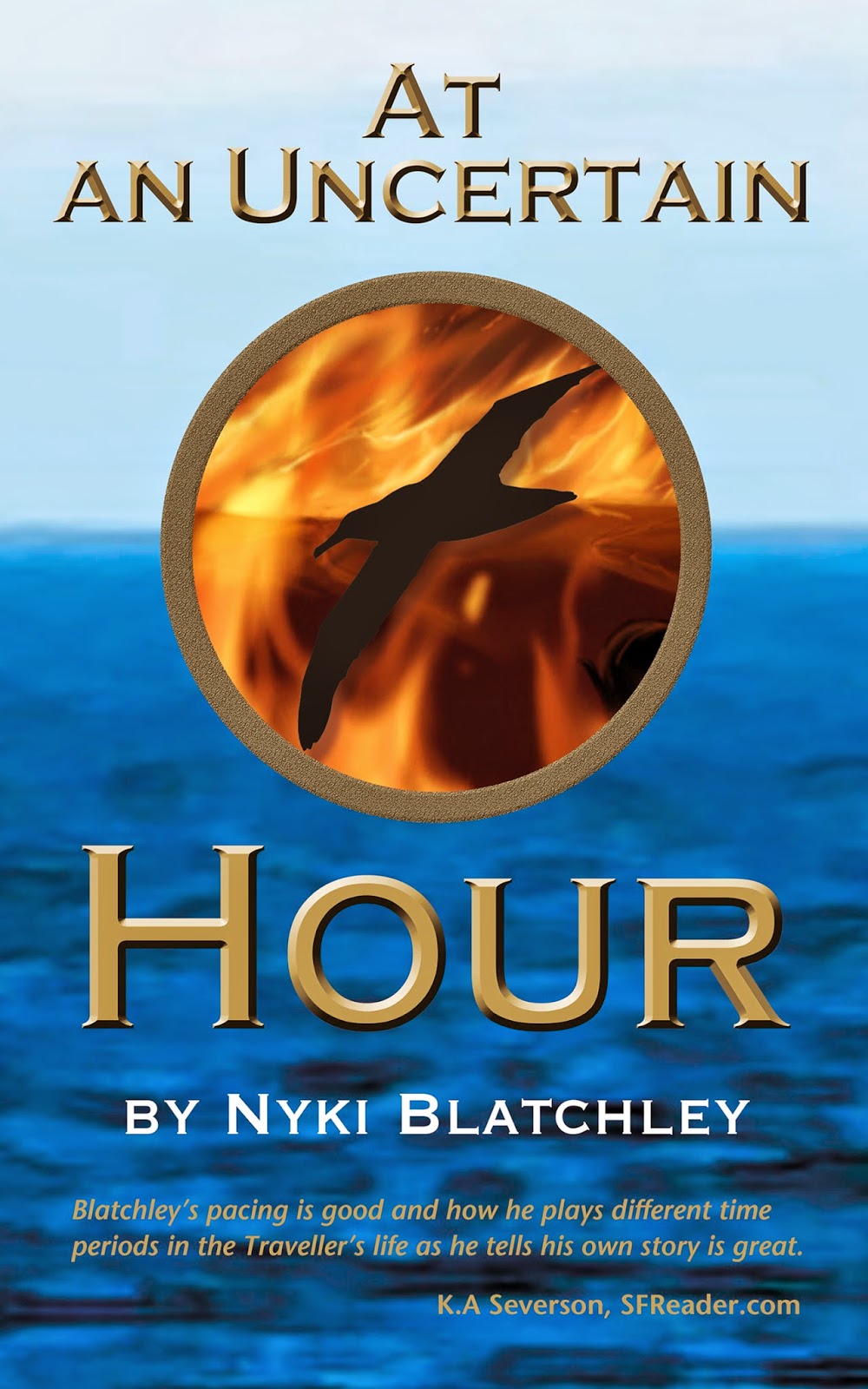
There are positions in between these extremes, and it's also not essential to write an entire story from the same position. In At An Uncertain Hour, for instance, I used the technique of switching between action the main character is immersed in as it happens and memories of his past life, written in a more distant style. I'm by no means the only author who's written like this — check out Iain Banks for a master of the technique.

Third Person


Third person, where every character is referred to as he, she or it, is perhaps the most natural style of storytelling, but it comes in three broad forms: objective, omniscient and limited.

Limited third is perhaps the most popular POV today, although its popularity is maybe exaggerated somewhat by authors and editors. This is where, in any given scene, everything is filtered through one specific person's perceptions and inner thoughts. The greatest sin, if (but only if) you're writing in limited third, is head-hopping, where the POV changes from one paragraph to the next, or even within the same paragraph. Even this can be done effectively, but only if it's deliberately calculated for a specific effect, rather than to make life easier for the author.

The POV may be limited, but that can be handled in a number of ways. It can be deep and immersive, to a point where it's almost indistinguishable from immersive first person, or the "camera" can move out to show us details that aren't being directly noticed by the character. At its shallowest, for instance, you might describe the character's appearance as if from outside — without resorting to the dreaded mirror scene.

That level more or less merges into omniscient, which is where the POV is the author (or at least an authorial presence) who can show us whatever is necessary to tell the story, including the thoughts of multiple characters, general facts about the setting, and pithy comments about life, the universe and everything. It's distinct from head-hopping, though, because the revelations made by an omniscient narrator are made from outside rather than inside, reminding us that this isn't the character telling us what they're thinking, but the narrator knowing it.

The most extreme omniscient approach is the storyteller style, where the author is a direct presence addressing the reader. This is particularly common in a traditional style of children's story, where the author might interrupt the narrative to say something like "I expect you're wondering how he's going to escape from this. Well…"

Occasionally, the omniscient POV can also be a character within the story, usually playing a minor role, who either for specific reasons or just as a device has access to all the necessary information about the story and its setting. This character can be presented as either first or third person.

Objective is superficially a little like omniscient, since the POV is the author, but where omniscient is an active POV, objective is passive. Here, we're only told what can be seen and heard, not what any character makes of it or what they're thinking. Not much fiction is written this way nowadays, partly because it's incredibly difficult to write it effectively (I know, I've tried) but the mediaeval Icelandic sagas3 handled it brilliantly, using it to give a kind of dead-pan insight into the behaviour of the characters by inference, not by revelation.

This doesn't mean that a writer has to choose one of these precise positions and stick with it fanatically. Many writers who use limited third, for instance, will vary the depth from scene to scene, depending on what's needed at the time. Others operate right on the edge between shallow limited third and omniscient, sometime straying to one side of the border, sometimes to the other — the Harry Potter books are an example of this. The key, as with so much in writing, is always to know precisely what you're doing and why. It's possible to make your variations seem natural, rather than careless.

Who Should Be Your POV?


Some stories can be told exclusively through one pair of eyes. This is the default for first person, and many limited third stories also don't need more than a single POV, if the story is about that person. Other stories aren't about any specific individual and need a wide range of viewpoints to show the reader everything that feeds into the edifice the author's constructing.

George R.R. Martin is one of the best-known authors using a POV cast of thousands, but many stories require three or four POVs to cover everything. These POVs (usually in limited third person, though multiple first person novels are found4, and even switching between first and third for different POVs) will change either at the beginning of a new chapter, or else at the beginning of a discrete scene within a chapter. The technique is completely different from head-hopping.

A common piece of advice in choosing which character stands as your POV for a scene, a chapter, an entire novel, is that it should be the person most involved in what happens. That's often good advice, but not always. Sometimes, the person most genuinely involved in a scene, in the true sense, may be standing back and watching events unfold. Someone else may take centre-stage, but this is the person whose motives and assumptions are being challenged by what happens, which will affect their role in the rest of the story.

An extreme case is when the story is most effectively told by an observer, giving us a separate mind to filter the action through. The best-known examples of this are Dr Watson in the Sherlock Holmes stories and Nick Carraway in The Great Gatsby. Though not at all uninvolved, Watson stands a little back and provides us with the eyes to watch the enigma that is Holmes, while Carraway allows Fitzgerald to avoid having to reveal too much about Gatsby.

In the end, the choice of POV — the character, the pronoun used, the limit or omniscience, the immersion or the distance — is all about how to tell the story best, and that will be different every time. As it should be. The point of being a writer isn't to endlessly tell the same story.


1 This caused some problem for Henry VIII's minister Cardinal Wolsey, who grammatically but undiplomatically referred in his Latin letters to "ego et rex" (I and the king). This gave ammunition to those who accused him of arrogance.

2 In fact, there's a little wiggle-room here, since applying that too literally results in the extreme immersive first person style known as stream-of-consciousness — a valid approach, but one that isn't suitable for the majority of first person stories. As long as what you write is more or less in the moment, readers will normally ignore any slight discrepancy.

3 No, the sagas weren't oral tales told round the fire of a mead-hall. They were actually sophisticated literary works, produced by and for a surprisingly literate society.

4 Disclosure: I'm writing one myself at the moment, and finding the process fascinating.

Monday, August 10, 2015

Which World Is Your Story Set In?

People who don't like fantasy often base their objections on the claim that they prefer to read books or watch films set in the real world. For these people, the dichotomy is obvious. Fantasy is set in an invented secondary world, which obviously makes it trivial and irrelevant, whereas good fiction (that is, whatever they happen to like) is set in the real world, which automatically makes it superior and relevant.

Leaving aside the fact that many of the books, films and TV shows ostensibly set in the "real world" are neither superior nor particularly relevant (the James Bond stories are nominally real-world stories, for heaven's sake), this attitude shows a fundamental lack of understanding about the nature of fiction — not to mention the nature of reality.

My contention is that every story ever written is actually set in an invented secondary world, and fantasy (as well as some SF) is the label given to those that are upfront about it. It doesn't matter how uncompromisingly gritty a slice of social realism a story might be, it's set in a fictional reality, not an objective reality.

Consider two authors both writing stories about a maverick cop who rides roughshod over the rules and procedures. In one, he might be the hero who nails the bad guys that would get away if he played by the book. In the other, he might end up destroying innocent lives the rules were there to protect.

This isn't just a matter of attitude. Depending on their views or agendas (often, but not always, the same thing), each author will create realities in which their take on the story is objectively true. The first will quite genuinely be a world in which bleeding-heart liberals are letting the crooks get away to prey on their victims. The second will just as genuinely be in a world where the rule of law is the only thing separating the good guys from the bad.

Of course, a reader who entirely agrees with one or the other point of view will interpret that fictional reality as objectively true, but another will see the opposite as being true. The point is that the difference isn't between the attitudes of the characters within the story, but lies in the author's primary worldbuilding. This is analogous to the way Tolkien writes about a world in which morality has the force of a law of nature and can affect the outcome of events just as surely gravity or the weather. The differences can be a lot more subtle, though.

Soap operas* are generally presented as ultra-realistic slice-of-life drama, but actually they tend to take place in an odd half-reality. Besides obvious anomalies like location (EastEnders, for instance, is set in a rearranged version of London) there are usually odd social habits that are unlike anything you'd actually find, simply to facilitate the dramatic necessities. There isn't necessarily anything wrong with this, but it's not the real world.

Most of all, perhaps, the fictional reality of a story will be determined by selecting what to put in and what to leave out. The complete reality of our society contains everything from cosy village life to inner-city gang warfare, but the reality in which a story takes place rarely includes all this. The author will select what's relevant to go into the story, and the rest won't exist.

This kind of selection, like the two ways our maverick cop can go, largely reflects the author's views and/or agenda. The fictional reality of a story isn't the world as it objectively is, but the world as the author wants it to be — not necessarily wants as a good thing, but wants in order to make a point. It's set in a custom-made world, just as a fantasy story is, but masquerading as the real world.

Does any of this matter? I think it does. Fantasy is often accused of portraying unreality, but it doesn't pretend otherwise, concentrating instead on using that unreality to shine a light on the world around us.

The more the fictional reality looks like our own world, though, the harder it is to make that distinction. I recall an argument I had once with a work colleague — I can't remember the exact topic, but I think it may have been about the precise effects of particular illegal drugs. What I do remember, though, is that the killer argument presented by this otherwise intelligent person was "Of course it's like that. Didn't you see EastEnders last week?" To which I gently explained that it had been that way in EastEnders because that was how some author had written it, not because it was necessarily true.

Fictional reality isn't restricted to fiction. Each of us sees the world in a slightly different way from anyone else, selecting what we admit and what we don't, explaining events according to our own assumptions and interpretations of reality. Most of the conflicts in the world are due to the fact that we do this unconsciously and assume our own fictional reality, whether individual or broadly shared, is objectively true.

If we could learn to understand how fiction works, critique it not in absolute terms but in terms of its unique fictional reality — its own secondary world — maybe we'd be better at understanding our own and others' unique inner worlds.

And what place better to learn how to do that than fantasy?


* The term soap opera is used with different meanings in different parts of the world. I'm using it in the usual UK sense of a continuous series (ie no breaks or seasons) about some kind of community that takes place in real time, so that, for instance, the characters are preparing for Christmas or anticipating the Cup Final at the same time the viewers are.


Monday, January 26, 2015

What Kind of Characters Do You Write About?

One of the questions an author is sometimes asked (not as often as "Where do you get your ideas from?" or "What's your book about?" *, but sometimes) is "What kind of characters do you like writing about?"

The short answer is whatever characters the story needs, but that's something of a cop-out. Much as we all like to vary our characters, most authors have a tendency to gravitate to some particular kind of character, whether that's a matter of gender, age, personality or lifestyle. So what kind of characters do I like writing about?

One thing I have noticed is that I seem to like writing about teenagers. Not in a YA sort of way, since the perspective tends to be standing a little apart and making gentle fun of the naivety and silliness of adolescence. It's not really a new thing, though. From what I can remember of the stories I was creating at about ten or eleven (none of which have survived) the important characters were always between about sixteen and eighteen — which, of course, was very grown up then, although perhaps young enough to be relatable.

When I started writing The Winter Legend, in my later teens, most of the main characters were still of a similar age, and this has largely survived innumerable rewritings through the decades. And I still use characters of that age a good deal. Estent, the protagonist of The Treason of Memory, is around eighteen, although his age isn't given in the story. Zadith and Musu, in The Lone and Level Sands, are a little older, but not much over twenty, while my recurring characters Kari and Fai (Steal Away, The Temple of Taak-Resh) are around sixteen or seventeen.

Not everyone's that young. The Traveller measures his age in millennia, and the age he "stuck" at is around thirty, but he's in his teens during a number of the chapters in At An Uncertain Hour.

On the other hand, I do like watching characters grow up. The Winter Legend covers about twenty-five years, and the central characters go from teens to early forties, turning from the struggling young heroes to the wise guides, in much the same way that Obi-Wan grows through the Star Wars films.

Perhaps my favourite example of this is Eltava, MC of seven published stories as well as having a cameo in At An Uncertain Hour. In the earliest story I've written about Eltava, Witch, she's fourteen (though I do have flashbacks in a couple of stories to her as a little child), but I've shown her through her twenties, thirties and forties, right through to Storm-Blown where she's in her late sixties. It's been a fascinating ride to watch her growing and developing while still remaining essentially the same person.

In gender terms, although I haven't done a statistical count-up, I suspect I have a roughly 50-50 split, although if anything my first instinct is more often to focus on a female. That's something which has certainly changed through the years. When I was first writing, almost all my POV characters were male, and I deliberately set myself the aim of using more females, but that seems to have become a matter of instinct now.

I'm not sure why this is, but perhaps it has something to do with otherness. Unlike some authors, I don't create characters to explore myself. I prefer to explore what it's like to be someone completely unlike myself and, though I can certainly do that with male characters **, being a female for a story gives the otherness an extra kick.

As for lifestyle, I tend to write about characters who are pretty much footloose wanderers. Perhaps that's an element of wish-fulfilment, since part of me has always been attracted to the idea of being a rootless traveller, although that's balanced by the other part that wonders how I'd lug a thousand-odd books around with me. Perhaps having a very large ship all to myself would help.

The Traveller and Eltava are both wanderers for life, although the Traveller might spend a decade, or even a few centuries, in one place sometimes. Kari and Fai, in their inimitable adolescent style, are homeless, outlaw sorcerers and love every moment of it. Even people with more roots and responsibilities tend to be wanderers, like Ferriji, the protagonist of Present Historic, a middle-aged international diplomat who travels constantly across the world trying to save it from itself.

Other people have wandering thrust upon them, like Estent, who begins The Treason of Memory with a place in his society (quite a high place, too) and finishes it as a homeless exile. In the final part of The Winter Legend (currently finished but by no means finished with) someone from a primitive mountain tribe refers to the difference between those who "stand above the valley and make sure everything [they] can see is as [they] want it" and those who want " to travel to the distance, as I do, and see what’s beyond it." She adds that it's important to have both kinds of people, and I can see her point, but travelling to the distance is more interesting to write about. For me, at least.

So there are a few of the character types I like to write about. I've created all kinds who are utterly different, but, if I switch off and just write by instinct, the chances are I'll be writing about a teenaged wanderer who wants nothing more from life than to discover what's beyond the distance.

 
* Answers: "From the ideas shop round the corner" and "It's about 400 pages".

** I've never been three thousand years old, I've never sailed the world on an enchanted ship, and I've never led an army. Just thought I'd mention that, in case you were wondering.

Tuesday, September 9, 2014

Writers Who Made Me What I Am

Some time ago, I wrote a blog on Ten Authors Who've Changed My World, looking at a few of the authors who've had most effect on me over the years. For this post, though, I thought I'd have a more inclusive look at my early influences. Nothing precise, but I don't think I'll be including anything that I discovered past my mid-twenties.

It's not comprehensive, obviously. As Bob Dylan put it, Open up yer eyes an' ears an' yer influenced an' there's nothing you can do about it. I've probably forgotten some of the authors who had some specific effect on me, and there may be one or two I'd be reluctant to admit to, but these are the main ones. I'll go through them in (roughly) chronological order, rather than trying to work out the order I met them in.

Homer. No, not the yellow guy, the Greek epic poet. I read Homer (in translation) in my teens, as well as retellings of the stories, and I think he helped to encourage my sense of the grand and epic. Battle scenes, questing, encounters with wonders and monsters: it's all there in Homer.

Thomas Mallory. From quite a young age, I was reading retellings of the Arthurian legends that Mallory collected and framed in the way we know them today, and I later read the original. It made me passionate about everything concerning knights, real or romantic, and the episodes in the Arthurian cycle have influenced me in more ways than I can count.

William Shakespeare. Well, why wouldn't I be influenced by arguably the greatest writer ever? Everyone else is, whether they're aware of it or not. Besides his wonderful use of language, perhaps the two specific aspects of Shakespeare's writing I'd pick out as major influences are his characterisation and the sense of pacing in his scenes. I also borrowed from Henry V for a crucial scene in At An Uncertain Hour.

William Blake. Poet and artist, Blake has been described as a hero of the imagination. I think one of the big things I took from Blake is that he was possibly the first author who deliberately created a mythology with a modern(ish) sensibility. Blake's mythological figures are allegories of various aspects of the human psyche, but they also work convincingly as people in their own right.

Samuel Taylor Coleridge. Barring Shakespeare, my absolute favourite poet, and his Rime of the Ancient Mariner is my favourite poem — I could once recite it by heart, though I think too many neurons have died off since then. The Ancient Mariner is a key influence on the Traveller (who even uses an albatross as his banner) though the contrasts are as significant as the similarities. The title At An Uncertain Hour is a quote from the poem, while another Traveller story, Ancestral Voices, has its title taken from Coleridge's Kubla Khan.

William Butler Yeats. Another favourite poet, Yeats was the writer who got me fascinated in Irish mythology and the whole of the Celtic Twilight. Any wistful, magical aspect to my writing almost certainly has a flavour of Yeats in there somewhere.

William Morris. Arguably (or arguably not) the first fantasy writer to set his work in an invented world for its own sake. I first read Morris's fantasies in my late teens and was enchanted by the mixture of mediaeval exoticism and earthy reality. He was also an important socialist thinker, and a surprising amount of that creeps into his tales of knights and damsels — actually, his heroines are usually of peasant stock and far stronger than the heroes.

Lord Dunsany. Largely responsible for bringing the exotic for its own sake into fantasy, and a master of evocative naming, Dunsany created impossible palaces, the wonders of Elfland and houses built on the edge of the world. When I write of far-off, wonderful lands with resonant names, I'm almost certainly channelling Dunsany.

James Branch Cabell. Cabell, I have to admit, is something of a "take what you need and leave the rest" author. He was of his time and place (1910s and 20s in Virginia) and some of his attitudes are rather unpalatable today. If you can look beyond that, though, he was almost unique in writing fantasy that seamlessly combines comedy and romance. Perhaps his biggest influence on me, though, was the way he wove a connection between apparently unconnected books, creating a vast web of story, something I've attempted to do.

A. A. Milne. I suppose my first favourite author. I was having the Winnie the Pooh stories and poems read to me before I can remember — and I should emphasise that I'm talking about the real stories, before Disney got his hands on them. Milne was brilliant at showing characters at a stroke. One of my all-time favourite bits of characterisation is Rabbit, who never let things come to him but always went and fetched them… He's probably, more than anyone, the reason I first started writing stories.

H. P. Lovecraft. I read Lovecraft first for his Dunsany-inspired fantasy stories, but then I went on and read the Cthulhu Mythos ones too. Horror isn't my primary interest, but there are certainly dark things in many of my stories, and I learnt a lot about darkness from Lovecraft.

E. R. Eddison. Not all great influences need to be flawless. Eddison has many faults, but he was the first modern writer to create epic fantasy as we know it. The genre got diverted into elves and dark lords, but Eddison approached it politically, much as Martin does (and I do at times), and wove a Machiavellian strand into his epics.

Robert E. Howard. Now, I have been known to make fun of the stereotypical Giant Barbarian Hero (Ug the Barbarian, I call him) but Conan as originally written by Howard still stands up well. In any case, he's one of the great fantasy archetypes, and I've certainly learnt a lot about writing exciting adventure from reading Howard.

Fritz Leiber. I never read much of Leiber's SF, but his stories of Fafhrd and the Gray Mouser made a huge impression on me. There's a lot that I could pick out as influences, particularly the mixture of light hearted and adventurous, but I think what he mostly taught me was how to write a story with two equal main characters. Sometimes it seems as if the real main character in those stories isn't either Fafhrd or the Mouser, but the interaction between them. I've tried to emulate that when I'm writing similar kinds of story.

Jack Vance. Again, I've neglected Vance's reputedly excellent SF and concentrated on his hugely influential Dying Earth tales. I've picked the odd idea from his magical system for some stories, but perhaps the biggest single thing that I stoleborrowed is his word Overworld. Vance's Overworld and mine are radically different concepts, but that was where the inspiration came from.

Mervyn Peake. Peake and Howard probably stand at opposite ends of some spectrum or other in fantasy, but both have influenced me in different ways. The weight and gravity of Gormenghast, its slow oppressiveness, are feelings I've occasionally tried to emulate.

C. S. Lewis. The Chronicles of Narnia were among the first fantasy works I read, along with the Arthurian legends and E. Nesbit, and they've soaked too far into me to have a hope of assessing. One influence I can't deny, though: my decision at fifteen to create an enemy in The Winter Legend who makes endless winter was almost certainly inspired by the White Witch.

J. R. R. Tolkien. I read Lord of the Rings at fifteen, and the world changed. I'm well aware of his faults now, and I don't actually want to write like him, but my ultimate ambition as a writer is to create something as great as Tolkien did. He's still my idol.

Geoffrey Trease. A children's historical fiction writer, not a very well-known author these days and has distinct faults (including his insistence on shoehorning a boy and girl into all periods, however implausible) but he got me into reading historical fiction. It makes a natural companion to fantasy, and it was reading Trease and others (certainly not school lessons) that really sparked my love of history.

Rosemary Sutcliff. Having read Trease, I got into Sutcliff, a much classier YA author of historical fiction. She wrote about a range of periods but mostly Roman Britain and mediaeval England. Among many things I learnt from her books was portraying friendship, with all its ups and downs.

Mary Renault. Sutcliff remained a favourite, but my growing love of Greece led me to possibly the best historical novelist I've read. Renault covered Greece from Theseus to Alexander the Great, and I've been told parts of At An Uncertain Hour show a strong influence from her. It wasn't deliberate, but not surprising either.

Andre Norton. Norton's Witch World series is perhaps most important for introducing a style of epic fantasy more based on people and relationships than headlong action, which has influenced many more recent authors. One very specific inspiration for me, though, was her way of writing unrelated stories set on different continents of the same world, which I've followed to an even greater extent.

Michael Moorcock. Moorcock's written so many books in so many different genres that it's difficult to narrow it down to a single influence. His Eternal Champion mega-series (which includes Elric, perhaps his best-known character) goes even further than Cabell in showing how so many different stories can be connected.

Ursula Le Guin. Earthsea is one of the key classic fantasy series, and there's a great many reasons for this. Perhaps the big influence on me was Le Guin's matter-of-fact racial mix, replacing the inevitable Eurocentric approach with a series where the main character is more like Native American.  I have a whole world to play with, and I routinely have non-caucasian main characters, such as Eltava who (if she came from our world) would be half Chinese, half Native American.

Doctor Who. OK, not a single author, but Doctor Who as a whole is one of my most important influences. I watched the first episode in 1963, and I've been hooked ever since, but it wasn't till someone pointed it out a few years back that I realised how much of the Doctor there is in the Traveller: a long-lived wanderer travelling in a miraculous ship, sometimes with companions, and getting caught up in causes by his devotion to justice.

Bob Dylan. Like Tolkien and Doctor Who, Dylan has been one of the overwhelming facts in the life of my imagination. His influence is more obvious on my poetry than my fiction, but he's certainly had a lot of effect on my ways of thinking and my habits of phrasing.

Karl Edward Wagner. He doesn't get a lot of mention these days, but Wagner had an intriguing habit of writing fairly standard sword & sorcery plots in an almost expressionistic way, giving them a strange and eerie feeling. Most of all, though, it was his immortal, nomadic Kane who gave me the idea that I could have a hero wandering through history, against the backdrop of different countries and civilisations in each story. It's served me well with the Traveller.

Well, it turned out to be a longer list than I expected when I started, but these are the most important authors who formed the writer I am now. There were plenty more, of course, and a lot of authors, from Mary Shelley to James Joyce to Poul Anderson, whom I enjoyed but can't pick out any specific influences.

It carries on, too, both with classic authors I didn't read till later (Chrétien de Troyes and George MacDonald, for instance) and newer influences. I've learnt a huge amount from reading both Mary Gentle and Iain Banks, but that's a refinement of the authors listed above, who formed the unformed in me.

Tuesday, February 11, 2014

Light of the Last Day - new fantasy anthology


Light of the Last Day
 
Edited by Nyki Blatchley & Natalie Millman
Cover art & design by Mette Pesonen
 
(also available on Kindle from other regional Amazons)


I've just completed editing, with Canadian fantasy author Natalie Millman, a new anthology of stories and poems by thirteen authors from all across the globe, spanning a broad range of styles and approaches to fantasy. All belong to the writers' peer critique group Fantasy-writers.org, and some are widely published authors.
 
The title refers to the theme we began with, combined with a selection of unrelated pieces, to write a story involving the phrase Waking to the light of the last day. Just that: it could be the last day of the world, the last day of an old life, or even the last day of a sporting season. We left it entirely up to each author to decide what to make of the phrase, and we had an enormous variety in their responses.
 
Let me introduce you to the contributing authors and their stories:
 
 
William Moon: Questions of the Creator is a brief tale about the end of a universe that's been a disappointment to its creator. But is that really all?
 
Leslianne Wilder: The Once and Future Kiss is a contemporary piece chronicling a relationship that doesn't proceed in the right order. And who is the mysterious seducer?
 
Mette Pesonen: besides providing the beautiful cover art and interior decorations, Mette contributes two lighthearted stories. Looking for Trouble is about a Hero at a loose end, while The Forming of Draakoa tells a legend from her wonderful realm of Hypnosia, governed by the Cliche Laws.

Nyki Blatchley: I also have two stories. In Lari's People, a ritual outcasting from a village proves not to be what it seems, while Dayglow illustrates the problems when a kind-hearted giant adopts a human baby.

Lindsey Duncan: The Scientific Method has a sorcerer trying to put right the catastrophe caused by his last experiment, while The Laughing Eye is a haunting poem.

Lee Kirk: Obsession is a time-travel story, but time-travel for something far more useful than killing your grandfather or stepping on a butterfly. Lee also contributes two short pieces: a chilling poem called Madness and a melancholy vignette called Tears.

Carl J. Snyder: Hair Apparent is the tale of a magic student that everyone picks on - until he's able to take revenge on his tormentors.

Erika Wilson: Ain't No Sunshine is a disaster story with a difference, as a group of survivors find non-human help and danger when Yellowstone erupts.

Natalie Walker Millman: Gaia gives a heartbreaking picture of just how far we've turned away from Mother Earth, while The Story Tree is a chilling fable of crime and punishment.

L. M. Price: Peter and the Monster is a children's fairy-tale of an unlikely symbiotic relationship and what happens when it's disrupted.

Lydia Kurnia: Eishenan tells of a boy caught up in a cosmic war between the Sun and the Moon. He's trained to be a heartless killer, but can he really be changed that much?

Jens Hieber: In Drops of Peace, a messenger of the gods comes to offer a rebel goddess redemption or punishment. Which will she choose?

Julie St. Thomas: Milla is a deceptively simple tale of a father's concern when he has to leave his young daughter home alone. But all is not quite as it seems.

So those are the authors and the stories. I hope you enjoy Light of the Last Day.

Thursday, April 11, 2013

Iain Banks - A Tribute

You may have heard that, a few days ago, the Scottish author Iain Banks — who also writes under the cunning disguise of Iain M. Banks — announced that he has terminal cancer and isn't expected to live more than a few more months.  Banks (with or without the initial) has been among my favourite authors for nearly two decades, and I'd like to take the opportunity to pay a personal tribute to him.

I first encountered Iain Banks (literally) in 1995.  He was on my radar as one of those "authors I must try sometime", and one evening I had an hour to spend (I never "kill" time) in Islington.  This was no problem, since there was a large bookshop open, and I went in to find Iain Banks at the nearly-deserted tail-end of a signing session.

Deciding this would be the ideal time to make a start, I paid for a copy of his latest paperback (Whit) and approached him with the book in a bag.  "Ah," he said enthusiastically, "I know what you've got in there.  It's a book, isn't it?"  Something possessed me to say, "No, it's a box of chocolates, actually," which he seemed to find funny.  The upshot was, I have probably the only copy of Whit in existence autographed by Iain "Cadbury's Selection" Banks.

I read Whit and was enchanted by it.  I'm not a wide reader of realistic fiction, but Banks has a playful, sideways view of reality that means his books are anything but like merely sticking your head out of the window.  I found it inventive, witty, thought-provoking and, most of all, filled with great characters, especially the main character Isis, and it remains one of my favourites.

After that, I worked my way, in no particular order, through the books of both Iain Banks and Iain M. Banks (according to the story he tells, Iain M. Banks was the name he originally wanted to use and was talked out of, and then suggested it sarcastically when told he had to publish science fiction under a different name).  Some were from the library, although I now have my own copies of those, and the more I read, the more I was sure this was an author I could really relate to.  Naturally, there are books I'm less enthusiastic about than others, but he's published nothing I didn't enjoy, and many I truly love.

His work ranges from exuberant space opera, through more surreal SF and magic realism, to straight(-ish) realism, but his books, however unique in their ideas and characters, always have an unmistakable Banksness.  That includes the books written both as Iain Banks and Iain M. Banks.  There are certain differences — the mainstream novels, for instance, usually focus on a single main character, whereas the SF ones tend to have a number — but essentially the same approaches are applied to the different subjects.

He's one of the few authors I've read who excel at both characters and ideas.  He has a habit of creating main characters you wouldn't expect to feel affection for but do — his debut, The Wasp Factory, was about a genuinely engaging teenage psychopathic killer.  More typically, his central characters tend to be exasperating but endearing, and most of the books are populated by a dazzling supporting cast.  He has a particular talent for portraying children and teenagers, seen simultaneously through their own eyes and through a more distant, adult point of view.  It's a rare knack, which I've tried to emulate at times.

He tosses off fascinating ideas, too.  One somewhat recurring theme seems to be taking a traditional bugbear and showing it as not really so bad.  This is especially true of his main SF setting, the Culture — a society run by machines that actually promotes human freedom and individuality, rather than suppressing them — but it can also be found in The Business, with a secret global company that owns everything but is, if anything, rather benevolent, and in Whit, centring on a secret religious cult that's daft but harmless. 
 
And his turn of phrase is second to none.  Who can forget the opening sentence of The Crow Road - "It was the day my grandmother exploded"?
 
Besides enjoying the books as a reader, I've also learnt an immense amount from them about writing, and most of all about writing in a non-linear way.  Banks almost always writes several time-periods simultaneously, weaving a complex pattern of flashbacks that gradually reveal the solution to a mystery — sometimes a mystery to the characters, sometimes only to the reader.

When I began writing my novel At an Uncertain Hour, I knew that had to be written largely as reminiscence and flashback.  I'd already encountered this in a number of Banks's books, but it happened I was just in the middle of reading The Crow Road, often considered one of his best.  Although my story was a fantasy covering several millennia, not a contemporary novel covering several decades, it was The Crow Road that taught me how to deploy my own non-linear complex.  I suspect my book might not have been published without that example.

So I owe an immense amount to Iain Banks, both as a reader and a writer.  I'm currently reading, and thoroughly enjoying, his recent novel Stonemouth, after which I have two of his SF books still to be read, and his forthcoming Quarry.  I hope for a miracle cure, of course, but realistically Quarry will almost certainly be his last.  After that, I'll just have to reread his books.

So, Iain "Cadbury's Selection" Banks, thank you for being amazing.  You'll always be one of the best.

Saturday, March 2, 2013

What Real World?

There are two boringly inevitable questions fantasy writers and readers are asked about their favourite genre.  One is, "Why read/write fantasy?" to which, of course, the short answer is, "Why not?" with the supplement, "Why don't you ask the same question about any other fiction?"

The other, which also has a short answer, is, "Why don't you read/write books set in the real world?"  The answer to that, of course, is, "What real world?"

The fact is that no fiction, of any kind, is set in some objective world that we all inhabit.  All authors invent a world to set their stories in; it's just that fantasy authors are more honest about it than most.

There are many ways of doing this, some more subtle than others, but perhaps the two main methods are the choice of what to include and exclude, and the presentation of moral beliefs as fact.

The inclusion issue, of course, can skew what we see as reality in any context.  Some years ago, there was a TV advertisement for one of the "quality" newspapers (I forget which) that was based on the proposition that you have to see the whole picture in order to know what's happening (which, naturally, that paper provided). 

It presented three short clips.  In the first, a skinhead youth runs up to a respectable-looking man on the street and shoves him hard.  In the second, the same skinhead is lounging on a street-corner when a police car draws up.  An officer leans out and shouts, and the skinhead turns and runs away from the car.

The third clip shows the whole scenario.  The man is standing under a cradle of bricks that's coming loose.  The skinhead, alerted by the officer's shouted warning, runs over and, at some risk to himself, shoves him out of the way just as the bricks come crashing down.  Without telling a single lie, the first two clips had the skinhead tried and convicted, whereas he's actually a hero.

Of course, even this isn't "the whole picture".  That might include the reasons why the accident happened (personal carelessness or corporate corner-cutting), who the man was waiting for, why the skinhead was at a loose end, what in his background made him risk his life to save the man... and so on, right back to the Big Bang.

In a work of fiction, some aspects of the "real world" are included, and some aren't.  This may be nothing more than what is or isn't relevant to the story, but even so, the author has to choose what story to tell.  It's often been pointed out, for instance, that Jane Austen's novels include none of the poverty, vagrancy and social unrest that was widespread at the time.  That doesn't mean she was unaware of it, or even unconcerned about it as a person, but she chose to write stories in a fictional reality in which those things didn't exist.

That doesn't make the stories "wrong" or even unrealistic.  They're very realistic about what she chose to present, and no author can cover everything.  It does mean, though, that they're set in a world of their own.

The presentation of moral belief as fact is a more complex issue.  Consider, as an example, a familiar type of character: the maverick cop who ignores the rules, and sometimes the law, to get the bad guy.  This can take place in either of two distinct realities (or a spectrum in between): the reality in which liberals are allowing criminals to rule the streets, and only ignoring the rules can safeguard decent people; or the reality in which the rules are there to protect the innocent, and ignoring them destroys lives.

This isn't just a matter of what happens in the story.  The different versions are actually set in different fictional realities, in which the author's belief (or the belief s/he thinks will appeal to the target reader) is a universal fact.  These are invented worlds, just as much as anything produced by fantasy.

Does it matter?  Ideally not.  When fantasy readers read of fictional realities, we understand them in the spirit they're meant: we learn broad lessons from the characters and situations or we just enjoy them (preferably both) but (apart from the very few who are always going to be out of touch) we don't believe in their objective reality.

Unfortunately, not all consumers of fiction have had our practice, and often seem to believe precisely that various kinds of popular fiction are objective reality.  Soap operas are particularly adept at creating this illusion, since their stock-in-trade is that they're presenting some kind of slice of life, even though they're doing nothing of the kind.  I've had arguments with otherwise intelligent and level-headed people who've based their arguments about the real world on what's happened in Eastenders or Coronation Street.  If they're challenged, of course, they'll acknowledge that it's happened that way because of the author's choice, but it doesn't seem to occur to them without the challenge.

Fictional realities are essential for stories.  No story could be written without them, and they only become a problem when the reader or viewer isn't aware of their presence.  Perhaps those people should practice by reading fantasy.

So, the next time you're asked, "Why read fantasy?" perhaps you could simply answer, "To keep in touch with reality."

Friday, December 21, 2012

Snowfall - a story for Christmas

I haven't posted any fiction on this blog before, but I thought I'd give you a brief story for Christmas.  It isn't actually a Christmas story, although it's vaguely seasonal.  I hope you enjoy it.


It was his fevered, dying delusion, of course.  How could it be otherwise, after days stumbling through the burning sands of the desert?  Maybe death was kind, after all, and came as a cold, beautiful snow-fall.

He rolled onto his back, opening a parched mouth to catch the flakes, but they swirled too wildly in the wind – still the burning winds of the desert – and settled on his body instead.  Weak hands scrunched up suddenly wet clothes, so that he could bend and suck their moisture.

It was scarcely enough to dampen his mouth, but he felt at once refreshed and stronger.  Sitting up, he tried to peer through the snow, but it was falling heavily now, whiting out his surroundings as effectively as a sandstorm.

He got to his feet like a newborn foal, staggering on weak legs but gradually regaining balance.  Taking an experimental step, he realised that he was still walking on sand, even though the blizzard was now heavy enough for a complete carpet of white.

It didn’t matter.  Nothing mattered, except that he was strong again and happy.

“Will you play with me?”

He whirled around at the voice, and saw her standing where no-one had been a moment before.  She looked about ten: a pretty girl with a sparkling, impudent face, dressed in a thin summer frock, her feet bare.

When he didn’t reply – he tried, but no voice would come – she put her head on one side and asked, “Do you like the snow?  I thought you would.”

“Did you make the snow?”  His voice sounded harsh and unnatural in his own ears.  “Are you a goddess?”

She considered that.  “I suppose I am, in a way.  I’m not a scary goddess, though.  I just like to play.  Do you like snowballs?”

“Yes.”  It was a strange conversation, though entirely natural.  “But there’s no snow on the ground.”

The girl hit her forehead dramatically, pulling a playful face.  “I knew I’d forgotten something.  There is now.”

Looking down, he saw thick snow carpeting the ground for as far as he could see.  The girl bent down, gathering snow up into a tight ball, and threw it at him.  It didn’t sting at all, merely refreshed him, and he stooped to make his own snowball.

“Can’t catch me,” the girl called out, running away, but not fast enough to avoid being hit by his creation.  She squealed in delight, and they began a running, screaming snowball-fight that seemed to last for hours.  When they finally tired of that, they built a snowman together, and then lay exhausted, making snow-angels.

Finally, the girl reached over and kissed him lightly on the cheek.  “It’s time to go now,” she said.  “It’s all right, though.  You don’t have to go back to the desert.  I told you, I’m not a scary goddess.”

His body was lighter, less substantial than he’d ever known it, but that was all right.  The snow still fell, playing in the wind in and out of him, and his body and consciousness mingled with it, playing and swirling in all directions, until it was indistinguishable from the rest of the snow.

“Goodbye,” said the girl softly.  “Have fun.”
 

Thursday, December 6, 2012

The Treason of Memory out from Musa Publishing


The Treason of Memory
Nyki Blatchley
Cover by David Efaw
Published by Musa Publishing (Urania imprint)
$1.99
 
 
Young aristocrat Estent n’Ashne has been arrested for assassinating the king he’s always loved. He remembers the deed, though not why he did it, but the enigmatic spy Sharru seems convinced of his innocence. Together, the unlikely pair must search through the slums and palaces of the city of Jalkiya to uncover both political intrigue and an ancient evil. But how can Estent find the truth when he can’t even trust his own memory?
 
Combining the sordid world of espionage with dark magic, The Treason of Memory is an action-packed adventure story set in a fantasy world of flintlocks and rapiers. 
 

The House of Dreams in Lore


Lore Vol.2 No.2 (November 2012)
Edited by Rod Heather & Sean O'Leary
Cover by Christopher Allen
$10.95
 
The latest edition of Lore is out, featuring my story The House of Dreams. Featuring my recurring character the Traveller, the main character of my novel At An Uncertain Hour, the story was inspired by Walter De La Mare's haunting poem The Listeners, whose character is referred to as "the Traveller". Well, I couldn't resist, could I? The story gives my answers to the mysteries and enigmas in the poem.
 
The issue also features stories by Bridget Coila, Keith P. Graham, Steve Rasnic Tem, Colin Heintze, Stephen Mark Rainey, J.P. Boyd, Jeremy Harper, Nickolas Furr, Jeff Samson, Corey Mariani and Denise Dumars.


Thursday, July 26, 2012

Avoiding Clichés Like the Plague

In 1830, the novelist Edward Bulwer Lytton published a new novel, Paul Clifford.  At that time, the most usual way to start a novel was either to give a potted biography of the protagonist, or else to treat the reader to a lecture on the moral or philosophical theme of the story.  Bulwer Lytton, however, wanted to pitch the reader straight into the mood of his tale, as writers now are encouraged to do, so he opened with the immortal words, “It was a dark and stormy night...”

It wasn’t Bulwer Lytton’s fault that, nearly two centuries later, his fine opening would have become one of the most notorious of all clichés, beloved alike of parodists and beagles.  In the context of 1830, it was actually a pretty strong way to start a novel.

The English language is full (as is any language) of phrases and sentences coined long ago by some genius that are used thoughtlessly (and often incorrectly) by millions today.  It doesn’t matter too much if these are from well-known and respected sources, such as Shakespeare or Dickens (or even the final scene of Casablanca) since enough people realise that these are quotes and not meant to be original.  When the source is more obscure, this can be different.

Just as very few people today read Bulwer Lytton, I’d be surprised if anyone reading this piece has seen the 1931 film The Last Flight.  A tale of GIs going AWOL in Europe after World War I, it includes a scene where one character is badly gored jumping into a bullring in Spain on an impulse.  Asked why he’d done it, his friend comments, “Well, I guess it seemed a good idea at the time.”

Although it’s not known for sure, this appears to have been the origin of a phrase that can only be used now with an element of self-mockery.  It’s an excellent phrase, though, and easy to see why it’s become such a cliché.

And that’s the point: clichés aren’t intrinsically bad.  Quite the reverse: whether they’re phrases or plot elements, they only become clichés because they were originally such great ideas that everyone wanted to use them, not terrible things to be avoided like the plague.

Avoid like the plague.  For centuries, the plague was the scourge of Europe.  Imagine a combination of AIDS, SARS and bird-flu, and then multiply it by at least ten.  It terrified people, and anyone who heard that phrase would have felt in their guts just what it meant to need that badly to avoid something.

The phrases and situations authors try to avoid were all great ideas at one time or another.  What could make a better story than the heir to a great throne being raised in obscurity, only to recognised at the crucial moment?  Or two people who start as enemies and find themselves falling in love against their will?  The problem is that they’re too good ideas, and countless thousands of writers before us have already taken advantage of the fact.

That doesn’t mean these ideas or phrases can’t still be used, just that authors should avoid reaching for them automatically, rather than thinking of new ideas for themselves.  If a clichéd situation is what must result from the characters and situations you’ve created, then by all means use it – but use it, rather than just repeat it.  There’s always going to be a new twist, and unexpected approach, that can make the tiredest cliché fresh and exciting.

Like writing tragedies in blank verse, all clichés worked triumphantly in their day, but should only be used now if it’s the right, inevitable way to do it.  You might say that they all seemed like good ideas at the time.