Showing posts with label Musa Publishing. Show all posts

Tuesday, February 24, 2015

Goodbye, Musa

This weekend, I was among a number of authors to be shocked by the news that Musa Publishing is closing down. I have two books out with them, The Treason of Memory and The Lone and Level Sands, the latter only published just before Christmas, and they'd recently accepted a short collection of stories.

Before I go any further, I'd just like to say that, as far as I can see, Musa have acted correctly. Their explanation was that, although still solvent, they couldn't see a way of continuing and still maintaining commitments to their authors and staff, a matter they weren't willing to compromise on.

You hear a lot of horror stories about small presses imploding in far more damaging ways. Although the closure is heartbreaking, it would have been far worse to have had it anyway, perhaps a year down the line, amid a financial mire that could have seen all our books held hostage while the mess was sorted out. As it is, within a day of the announcement I had a full and clearly worded letter of rights reversion that will allow me to do what I want with my work the moment the doors shut on the 28th February.

Which brings me to the question: what am I going to do with these stories? As I see it, there are two options. I can find another publisher that considers reprints, or I can self-publish.

Before I even decide that, though, I have to make a decision on how I want to present them. These are all short pieces, either longer short stories or novelettes, and most have been published before — of the four pieces in the collection, two would have been reprints (something Musa were always willing to consider).

The six stories are loosely connected. They have no characters in common, but all take place in a later era of the world featured in At An Uncertain Hour. ranging from an early modern period to that world's computer age. Besides this, all involve something ancient, something magical — whether good, evil or in between — intruding on this modern, rational world, a theme common in real-world settings, but less so in secondary worlds.

This was the rationale behind the collection, so perhaps the simplest thing would be just to expand it to include the two stand-alone publications. That would give me a collection of around 50,000 words.

First stop, of course, will be to find out whether any publishers are happy to take submissions of fantasy collections that are partial reprints. I'm not expecting to find many — Musa were quite special in that regard — but I'm hoping there'll be one or two.

If not, I'm looking at self-publishing them. Four of the six stories have already been published, so the editorial process wouldn't be too difficult, and I have the comfort of validation that all have been considered good enough for publication. That essentially leave a cover, the book design and a lot of hard work, before the real fun starts — the promotion.

Quite apart from losing my publications, I'll miss Musa. It was always a company with good ethical values, and staff and authors were very much a family, everyone helping one another out. I wish luck to all the staff and fellow-authors, and I hope I'll be running into them a lot, whether it's seeing their books coming out or working with them at other houses.

And I'd like to single out for particular good luck Daniel Ausema, whose wonderful Spire City serial story has been cancelled in the middle of its second season. I can't believe that someone won't have the taste and common sense to pick this up, but whatever happens, good luck, Dan.

And good luck and goodbye to Musa.
 
P.S. The one slight upside of this is that Musa is having a closing-down sale. Until the 28th, both The Treason of Memory and The Lone and Level Sands are available for a mere 40c, and other books are going similarly cheaply. At least you can grab some great books for very little before they're gone.

Thursday, January 15, 2015

Fantasy and Archaeology on the Musa Publishing Blog


I feature today on Musa Publishing's blog, discussing links between fantasy and archaeology, especially in my new Musa ebook The Lone and Level Sands:

Fantasy and archaeology — they seem made for one another, don't they? After all, one of the most common ideas in fantasy is someone discovering ruins or a lost artefact from an ancient civilisation, yet real archaeology is very underused.

As an approximate concept, of course, it's always been there. The spectacular discoveries of the 19th century, when entire civilisations were being uncovered — what's been called the heroic age of archaeology — inspired authors like H. Rider Haggard and many others to write stories in which explorers found such civilisations not just as ruins to be dug up, but actually still surviving...
read the whole piece here


Saturday, January 3, 2015

2014 and 2015

Another new year already. Traditionally (by which I mean for the last two years, which seems to qualify as a tradition these days) I start the year by reviewing my writing achievements over the year that's finished and looking ahead to the year to come.

During 2014, my writing has been somewhat disrupted by… well, by writing. Since March, my official day-job has been as a freelance copywriter, and the work I've needed to put into building that up — which seems to be paying off — has severely cut into my creative writing time. Still, among all that, I seem to have got through a fair amount.

I'm not as far as I'd hoped through my current novel (working title The Empire of Nandesh) but I'm more than 50,000 words into it. I'd been hoping to be nearly finished by now, but both the copywriting and other projects have cut into it. I revised the novella The Dweller in the Crack, and wrote three shorter pieces, Finder's Fee, Turning the Tables and Gerda and the Darkness, but the biggest distraction was my very unexpected diversion into children's fantasy.

A few years ago, I wrote a very short piece called The Biggest Dragon in the World, which featured a sorceress called Cariana. I really wrote it for my own amusement, but it turned out as a children's story. During the summer, I attended a workshop of mainly children's authors and took the story along as my one qualifying piece. They loved it and encouraged me to expand it into a series.

I've now written half a dozen other connected stories, but the series took an unexpected turn when, in the second story, I introduced Cariana's nearly-eleven-year-old apprentice Flea, who's taken over as the central character. I'm having huge fun writing about her — in the most recent, she has an encounter with pirates — and the aim is to add perhaps three or four further stories and then, after revision, try to pitch it as a book.

I've begun self-publishing some of my out-of-print work, which has been an interesting process. I have mixed feelings about self-publishing, but it's a valuable option for an author with the experience and willingness to put in the work it needs. So far, I've republished At An Uncertain Hour, the novel previously issued by StoneGarden, and Steal Away, the first story about Karaghr and Failiu, which first appeared in the late, lamented Golden Visions. I'm also hoping to bring out the sequel, Rainy Season, also a Golden Visions story, and perhaps others.

As far as professional publication is concerned, December saw the publication of my second ebook from Musa Publishing, The Lone and Level Sands. A contemporary (or nearly contemporary) fantasy but set in a secondary world, this is archaeological fantasy somewhat in the Indiana Jones tradition. It came out just before Christmas, so I'm gearing up again to restart promotion.

Besides these, I've had stories in The Colored Lens (Damned) and Plasma Frequency (The Lady of the House and The PetrologicEngine, the latter my "flintpunk" story) as well as in three anthologies, two of which I was involved in producing. Light of the Last Day was the somewhat overdue anthology from Fantasy-writers.org, which I co-edited and contributed Lari's People and Dayglow, while the equally long-in-making The Tale Trove is the first production from my live writers' group, the East Herts Fantasy Writers. My contributions are Return Switch, Hanuut's Stand, I See a Voice and three poems. I've also appeared in Unburied Treasure, a follow-up to last year's Trespass, with the custom-written Finder's Fee.

So what of 2015? I'll probably continue to have less time to devote to writing than I did before last year, but I have The Lone and Level Sands to promote, and I hope to reissue Rainy Season this year. On a slightly longer-term basis, I've been considering self-publishing a collection of stories about Eltava. All but two have been published in various markets, and all rights have now reverted to me, so it might be a practical option. But a lot more work than putting out single stories.

I'll continue with both The Empire of Nandesh and the Flea stories, and hopefully I'll finish the draft of the former and have the latter ready for submission during the year. That's assuming I don't get diverted again. We'll see.

I'd like to wish you all a very Happy New Year.

Sunday, December 21, 2014

The Lone and Level Sands - the lost scene that began it all

For some years now, I've belonged to a group of online authors who get together once a week and all write for exactly an hour on whatever topic one of us sets. The object is to get us writing fast and with as little internal editor as possible, but the results are sometimes (though not always) gratifying. Many stories that started that way have been published, including no less than eighteen of mine. Some have been flash fiction that I completed in the hour and polished later. Others have have fragmentary beginnings that I've expanded into longer stories. My previous Musa book, The Treason of Memory, was among those which started that way.

Back in 2008, in response to the prompt "write a story about an object being dug up from the ground which radically alters your character's conceptions of the origins of something", I wrote what would eventually turn into The Lone and Level Sands. However, this wasn't the beginning of the story that Musa has just published, but a scene that takes place months earlier and in a different country.

For anyone who's curious, I give that original scene below. I've changed nothing, even keeping the different spelling of the main character's name. I've no idea whether the decision to change Zaddith to Zadith was deliberate or a typo, but he's unmistakably Zadith now.


“And these were dug up where, exactly?”  Professor Thalidri sipped his drink with the prim delicacy Zaddith had always found absurd in such a big man, peering over his glasses at the two graduate students before him.

“In the desert,” said Museve eagerly, evidently not noticing the corroding scepticism in their teacher’s tone.  “Twenty miles from the coast, near Lahlem.  There’s a theory...”

“Thank you, Ms Amwa,” the Professor interrupted, and for once the young woman fell silent immediately, her shoulders drooping a little.  “I assume you’re referring to the theory of the temple of Shetti.  I can assure you, it was a theory popular among the more... enthusiastic of students when I was your age.  I see that little has changed.”

“But, Professor.”  Zaddith usually let his friend do the talking, but he couldn’t contain himself.  “Surely this is evidence.  The fact that tablets like these have been excavated just where the temple’s supposed to be... Well, it’s evidence, isn’t it?”

“Thanks for your usual incisive analysis, Mr Zaddith,” said the Professor dismissively.

Zaddith squirmed in embarrassment and annoyance.  Though his papers always received top marks, he somehow couldn’t reproduce the same fluency in speech, and he’d learnt to keep his mouth shut in class, for fear of ridicule.

The annoyance was because he knew that Professor Thalidri was perfectly aware that his surname came last, not first as it did here in Qymssa.  He didn’t make the same mistake with Museve; but Zaddith had long since realised that the Professor disliked Northlanders and took that dislike out on him.

“Professor,” said Museve, her tone more conciliatory, “you must agree that it’s a significant find, whether the temple exists or not.”

Three pairs of eyes returned to the baked clay tablets strewn on the desk between them.  Zaddith and Museve had taken a risk smuggling them out of Hranti, one of the more unstable of the petty dictatorships that clung to existance in the Sruq Desert.  Officially, they risked prison for removing antiquities without a licence, but Zaddith suspected that they could very easily have been shot in secret, to become just two of the many people who’d vanished in Hranti over the past decade.

In the end, though, neither could bear the thought of spending months, even years, applying for a licence, maybe to be refused in the end.  Zaddith was still having nightmares at the thought of what might have happened, but they were clear.

“The script is clearly similar to Early Dembin,” commented Thalidri at last, less scornful as he immersed himself in the ancient texts.  “The language, though...”  He paused a moment, sounding out some of the symbols.  “It has certain structural similarities to proto-Sriwali, and... yes, some vocabulary in common too, I’d say.  Perhaps an extinct language from, oh, let’s say, four thousand years ago.”

The two students glanced at one another, and Zaddith wondered whether Museve would have the nerve to bring up their theory.

“We thought so too, at first,” she said, a little uncertainly.  “But there are elements that don’t appear to be Sriwali at all.  I... we think it may be an older language.  We think it’s the language of Kebash.”

There was a long silence, while Zaddith waited for the Professor’s sardonic laughter; but it didn’t come.  When he looked up, he saw that the older man was staring at them.

“Kebash.”  There was no inflection as he spoke the name.  “Are you trying to claim you’ve found the lost city of Kebash?”

Museve took Zaddith’s hand under the desk, clearly for support, and gulped.  “Not... not actually,” she said at last.  “The stories all talk about Kebash being overwhelmed by the sea as punishment for its sins, not buried in the desert.  But... the tradition is that Kebash was somewhere between Xeinnur and the mainland.  Couldn’t this have been an outpost?”


And that's where the hour finished, just when the scene was getting interesting. Kebash was a name that had come up here and there in other stories I'd written set in the same world, as an ancient, lost city that was the source of the most dubious magic. A kind of equivalent of Atlantis with a darker reputation.

I knew I wanted to write a full story based on this scene, but how? When I started thinking about the plot, it was very obvious that the story proper had to take place during the dig itself, and the later in the dig the better. This could serve as some kind of prologue, but that would feel awkward.

In the end, I made a fresh start, with the dig in full swing and Zadith and Musu (who had now acquired a diminutive of her name) watching the army trucks approaching across the desert. There was no place for this scene, although it is referred to in the story, and several of the points of discussion appear in a different context.

The Lone and Level Sands is, as it should be, a far more centred story, both in time and place, than would have been possible if I'd used this scene. But this is where it started, in terms both of the main characters and of the search for the Temple of Shetti and evidence of Kebash.

The Lone and Level Sands and The Treason of Memory are both available in all ebook formats from Musa Publishing.

Friday, December 19, 2014

The Lone and Level Sands out today from Musa Publishing


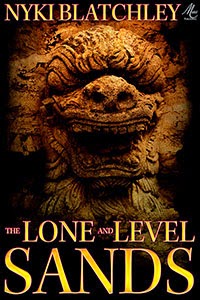
The Lone and Level Sands
by Nyki Blatchley
Cover by Kelly Shorten
Published by Musa Publishing (Urania imprint)
$1.99 in all ebook formats from Musa Publishing

 
The ancient ruins in the desert hide more than just scientific interest—evil lurks there from the dawn of history.
 
Archaeology students Zadith and Musu thought it would give them valuable experience to spend their summer break on an important dig in the desert with their professor. They didn't expect to be menaced by the local military, a rival expedition with unorthodox methods, or an ancient evil from the dawn of history. But this is no ordinary site. An outpost of the city of Kebash, lost for ten thousand years, it holds terrors worse than death for Zadith and Musu.
 
Set two hundred years after The Treason of Memory, The Lone and Level Sands is a thrilling fantasy tale of adventure and the supernatural.


Excerpt

It was large, at least thirty yards across and nearly as high, and certainly no primitive cave. The stone walls were straight and smooth, and the paintings that covered every inch only damaged in two or three places that Zadith could see. The colours were faded but still vivid enough to show geometric patterns surrounding panels of the ancient script. Zadith tried to make out what the nearest panel said, but he was too scared to concentrate.

The wall to his left portrayed a scene with stylised figures like the reliefs on the stone: a huge man wearing a tall bejewelled head-dress stood over cringing naked suppliants. Some were trodden under his feet, and one was transfixed by a spear he held. All around, jewel-covered men and women held their arms aloft, as if cheering the scene.

Zadith had seen similar images in pictures from some of the oldest tombs in this part of the world, but none was more than six thousand years old. If this place really was an outpost of Kebash, it must go back at least ten thousand years.

“Kebrai,” breathed Nivehl. “We’ve found it—the Temple of Shetti. This is where offerings were made to the god-king.”

“And that would be where they were given.” NeSholis pointed.

From the farthest wall, beyond the group in the centre of the chamber, a stone head protruded. At least fifteen feet high, it was a hideous demonic form like the one carved at the entrance to the passage, its huge open mouth forming a cavity big enough to take a human between the stone teeth. Zadith tried and failed to convince himself that was coincidental. The mouth was at just the right height to lift a victim inside, and he was glad the cavity was too dark to make out what might have been left inside.

“You can feel his power.” Nivehl turned to Thalidri, a sneer twisting her striking face. “Are you going to try to deny it now, sweetheart?”

He shrugged. “There seems little point.”

He was reacting more calmly than Zadith would have expected. He himself was shivering, and Musu was too. Nivehl was right about feeling the power: for the first time in his life, Zadith knew without question that he was surrounded by evil.

“Kebrai’s rituals demand blood.” NeSholis kept his eyes fixed on the demon face for a moment and then turned to Thalidri, boots snapping on the stone floor. “Have you not wondered why we brought you in?”

The Professor’s eyebrows drew together. “You’re proposing to sacrifice me? I think you might find difficulty fitting me in there.” He pointed at the mouth-cavity, certainly not designed for his bulk.

“Of course we are not,” said neSholis with a crooked smile. “That would be a waste. Any blood will do to summon the power of Kebrai, if the Codex is to believed, but a final gift is needed too. A special gift—a person who means something to the giver. A former lover, perhaps. Or a mentor.”

“Ah.” Thalidri clearly understood, but still seemed unruffled. “You’re speaking of the bargain-seal. Oh, yes, I’ve read that passage too. The bargain-seal must be given living to Kebrai, for him to keep alive in torment. So that’s to be me.”

“Entirely personal, my dear,” commented Nivehl. “I can assure you.”

NeSholis turned to the two students. “Bring the girl.”

Wednesday, January 1, 2014

2013 and 2014

2012 was a great year for me as far as publication was concerned, but 2013 seemed to slow down a little.  Even so, there's been a fair amount to celebrate.

Perhaps the biggest thing out was The Triarchy's Emissary, issued by a new South African epublisher, Fox & Raven.  This was a story I wrote several years ago for a shared-world anthology that collapsed before it was complete.  We created the world between us, and I've always been proud of the story I wrote for it, even though no-one was accepting it, so I'm grateful to Marius for putting it out and delighted to be helping Fox & Raven get off the ground.  Coincidentally, another contributor to the anthology also had an acceptance for her anthology story at around the same time, which was wonderful.

Following the publication of The Treason of Memory (still available) at the end of 2012, Musa Publishing have accepted The Lone and Level Sands, my secondary-world Indiana Jones style story about archaeologists, desert countries and ancient, haunted temples.  I don't have a publication date for it yet, but I look forward to getting to work on it.

Besides The Triarchy's Emissary, I've only had one story newly published this year — River God in the excellent magazine The Colored Lens, a story that combines fantasy with ecology and owes a little in influence to John Boorman's haunting film The Emerald Forest.

I've also had two reprints, though.  A Deed Without a Name, which featured during 2012 in Penumbra's Shakespeare-themed edition, reappeared in The Best of Penumbra Vol. 1, while Just Deserts featured in Leslianne Wilder's anthology Trespass (available from Amazon.co.uk and Amazon.com).  This story about Eltava and the spoilt princess from hell was first published by Quantum Muse in 2007, and I was a little mortified to find they'd published it as "Just Desserts".  Well, there was meant to be a pun along those lines, as it involved cannibals (just like the other pun referring to its setting in a desert) but I'm delighted, among other reasons, that it's now available under the correct title.

On the downside, StoneGarden.net, who published At An Uncertain Hour, have closed down.  Kris always ran it as a one-man-band, and he needed more time for other parts of his life, such as his family.  I wish him all the best, and many thanks for putting the book out.

The positive from this is that all rights have reverted to me, so I'm free to self-publish a new edition.  I have mixed feelings about self-publication — while it's a great option, much of what's put out seems in dire need of professional input — but as At An Uncertain Hour has already been extensively edited by StoneGarden, I see no reason not to go ahead.  I'm hoping it'll be back in print early in the new year.

Away from fiction, Fantasy Faction published my article series this year on The Chaotic Champion, a concept about the nature of heroes in fiction I began as a book in the mid-1990s but lost to a computer crash.  I've finally got around to writing it, although in a much shorter version than the original concept.  Still, it seemed to go down well, so who knows?  I may yet expand it into a book.  Links to all my Fantasy Faction articles can be found on my website.

On the writing front, the big news is that I've finally finished my trilogy The Winter Legend.  Well, apart from all the extensive rewrites, of course, but it still feels incredible to have a complete version of the project I first conceived nearly forty-five years ago.

I've now started on my next novel, with the working title at the moment The Empire of Nandesh, which is both sequel to At An Uncertain Hour and prequel to The Winter Legend.  Just to make it more difficult for myself, I'm writing it in four separate first-persons, with extensive flashbacks in all of them, in the same sort of style as At An Uncertain Hour.  Well, I wouldn't want to get bored, would I?

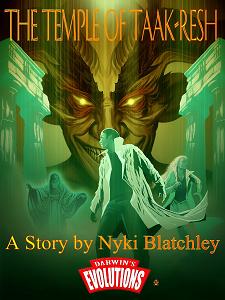
I only wrote four shorter pieces this year, though one was a novella — The Dweller in the Crack, a story about Karaghr and Failiu, whose tales could be viewed as my most successful series, since all three of the stories so far have been published, including The Temple of Taak-Resh.  This one, currently 26,000 words, still needs to be stretched and hacked into shape on the Procrustean Bed of revision, but I'm looking forward to having it finished.

So, onward to 2014.  As I said, I'm hoping to have At An Uncertain Hour back in print (physical and virtual) early in the year, and I have one outstanding story to come — The Lady of the House in the February/March issue of Plasma Frequency.

The Tryst Flame, the first part of the trilogy, has been to a few agents and will be knocking on the doors of many more in the new year.  The other two parts will need to be pulled into shape at some stage, but my priorities for now are to finish the draft of The Empire of Nandesh and get The Dweller in the Crack in a fit state for submission.  And hopefully there'll be other story ideas waiting to ambush me.

Happy New Year to everyone.  I hope all your projects turn out to be twice as successful as you planned.

Tuesday, December 17, 2013

Spire City: Guest Post by Daniel Ausema

One of the best authors I have the privilege to know — though only through the medium of the interwebs — is the Colorado writer Daniel Ausema.  Dan has a stunning ability to come up with strange and wonderful fantasy settings, and his latest venture, being published by Musa Publishing, is his Spire City serial.  Here he is to discuss it.


First of all, thanks to Nyki for doing this blog swap. I hope everyone reading this hops on over to Twigs & Brambles to give his post there a read as well.

I've known Nyki through his writing for many years, and one of the things he's done a stellar job on is posts about his worldbuilding process--how to create a secondary world that feels real and believable. One of the big differences in writing between Nyki and me is he has one fabulously invented world that spans thousands of miles and thousands of years, and most of his stories take place within that world. I don't have one world for my stories, preferring to come up with a setting depending on what a given story needs.

Several years ago, I read a wonderful story in one of the pro zines and followed on to the writer's blog. There she had a post with a title along the lines of “Confessions of a serial world-builder.” The writer wrote about how she creates new settings for every story, so that plot and character and setting all rise organically from each other. That resonated with me. I love to imagine new places. I love to evoke the mood and sense of strange cities and unknown lands. And the whimsical and surreal twists of an unknown place often give rise to and develop along with the stories I'm writing.

The danger, though, is that worlds made up on the fly can become thin. If immersion is important in a given story (which isn't always the case, but...), then the bare spots of a poorly imagined setting can work against that and weaken the entire thing. So how do you avoid that?

With my serial fiction project Spire City, I initially wrote a single short story set there. For that, the main character was a banker, and the mood was inspired by Kafka, so those two things affected what I needed to portray of the city. That's the first key. See your setting from the eyes of your characters. (And hear it from their ears, smell it from their nose, etc.) An obvious premise at first glance, but something writers don't always do well. Are the cobbles important to mention? They are if it's something your character would notice. The origin of the stone used to make them? Not so much in this story...and yet I'll keep in mind that it may prove important for some reason. The giant beetles that pull Victorian carriages through the streets? Perhaps. The singers chained to the city's steeples? Absolutely. The economics of how those singers are supported, fed, trained, etc.? In this story that wasn't important to him at first. He noticed the songs and the sounds of their voices. As the story progressed, he found himself needing to learn some of those other aspects, and so the world builds by necessity.

When it came time to do the episodes of Spire City, the banker was gone, as was most of the Kafkaesque mood, and there were going to be numerous characters whose minds would be our windows into the city. So I did spend some time just working through various aspects of the city. Regular, old-fashioned brainstorming. How does the city fit into the broader world? Does it have a local language, a dialect of a broader language, a mixture of languages? This question led to the presence of an immigrant community within the city, which proves important as the series progresses. And other questions helped tease out the various dimensions of the city, past and present.

At a certain level, too, you can have some things that you just present as true. It requires a certain arrogance that just says this is how things are. It was a dozen years ago that I first discovered some of the works that have been labeled New Weird. Part of what I loved about those books was that very sense of apparent arrogance, as if they were saying, “No, this doesn't make sense, but it's how it works anyway.” Because they're presented in the right way, their very improbable-ness is part of the enjoyment.

The last thing is key not just to this question, but to how I approach writing in general. Don't shut any idea down. As you write, give yourself permission to toss out the most random and bizarre thing that comes to mind. World-building, as Nyki has argued here on his blog, ought to be messy. Lines are never straight. People never fit perfectly into our preconceptions, and neither do cities or nations. Sometimes that bizarre thought will lead to an entirely new wrinkle that impacts all the other parts of the story. Sometimes it has little bearing on anything else. Yet even so, those kinds of things help make the setting more real. Even now, as I'm doing final revisions on the season 1 episodes, I find myself excited by new details that seem to come from nowhere and make the world of Spire City more real. Of course the immigrants' cooking consists primarily of a pungent gourd and glazed nuts. Of course Spire City has a tradition of folk tales about people becoming animals and transforming back, stories that will be especially poignant to our protagonists, as their infection is uncontrollable and permanent. (Actually I just came up with that as I wrote this post...but now it has to find its way in somehow...)

Thanks, again, for the chance to come here and for reading. Let me know any other tips you have in the comments, and check out Spire City, Season One: Infected when you get a chance. Episodes 1 and 2 are out, with episode 3 coming on January 10, 2014.

Spire City is home to mighty machines of steam power and clockwork, and giant beetles pull picturesque carriages over cobbled streets, but there is a darker secret behind these wonders. A deadly infection, created by a mad scientist, is spreading through the city, targeting the poor and powerless, turning them slowly into animals. A group of those infected by the serum join together to survive, to trick the wealthy out of their money, and to fight back.


Saturday, June 1, 2013

Living in a Flexible World

I just signed the contract with Musa Publishing for a second ebook, The Lone and Level Sands, to be issued under their Urania imprint.  This story is set in the same world as my previous Musa publication, The Treason of Memory (as well as many other stories, including my StoneGarden novel At An Uncertain Hour and my Darwin's Evolutions ebook The Temple of Taak-Resh) but in a different type of setting from those.

The two last, like a number of others, are set in what could loosely be called a standard setting for epic fantasy or sword & sorcery.  Hopefully not in a clichéd way — I try to portray a range of different types of pre-gunpowder civilisations, rather than the usual bland blend of something that vaguely passes for a cross between mediaeval Europe and ancient Babylon — but the stories have broadswords, horses, temples to numerous gods and so on.

The Treason of Memory, on the other hand, is set in a culture of flintlocks and rapiers, somewhat reminiscent of Europe in the late 17th/early 18th centuries, while The Lone and Level Sands has more in common with the mid 20th century.  This is a long way from broadswords, or even flintlocks, although perhaps not exactly like the equivalent period in the real world: land vehicles are mainly electric, for instance, and air travel comes courtesy of airships.

The Lone and Level Sands is archaeological fantasy.  Like parts of the Indiana Jones series, it's set in a desert country in an unstable world where anything could happen.  It has elements of a thriller — sinister rivals, trigger-happy soldiers, blackmail and betrayal — as well as the fantasy elements of a temple out of mythology and... well, you'll have to read the story, when it comes out.

Coincidentally, I have another story coming out later this year, in the excellent magazine Aoife's Kiss, which is related to this, to the extent that it's also a view of the same myth from a "modern" world.  This time, though, the culture is the computer age of the same world.  If you pay attention, you'll find a couple of more specific links between the two.

So what's the advantage of doing it this way?  Wouldn't it be simpler to create a world for each story, or at least each series?  A pre-gunpowder world, a world of flintlocks, and so on?  Just invent what I need, when I need it?

Well, it would be easier in some ways, but I think nowhere near as effective.  In a joined-up world, the ideas don't come in isolation, and they don't develop in isolation, either.  The legend behind The Lone and Level Sands is (hopefully) effective because it's a story I already knew, and the "modern" discovery has a history that make it comparable to finding a relic from Atlantis in our world.

The background to these stories isn't just a background — it's people and places whose stories I know and have written about.  That's a level of reality that's difficult to achieve in a one-story world.  Not impossible, but difficult.

The world I use offers me the means to write almost any kind of story I want, from epic fantasy to occult thriller — I've even found a corner to write something resembling steampunk — and stories come into being from the influence of their own past and future.  There are stories coming to me that need to belong to a different world, whether it's a one-off or an ongoing world, but I don't anticipate running out of fascination and inspiration in my flexible world anytime soon.  Probably never.


Wednesday, March 13, 2013

Guest Post - Joanna Fay interviews Xereth

Xereth has the dubious honour of being the lead villain of The Siaris Quartet. By some strange fortune (or quirk of his author), he is also the only character to be a viewpoint character across all four novels. This is his first public interview, so we cannot vouch for his behaviour!

JF:  Xereth, thank you for agreeing to an interview. I know this is dangerous territory, but would you like to start with a bit about your background?
X:   Are you asking me to pack 90 000 years into one sentence? Everyone knows who I am, don’t they? (sniffs) Very well, I was created by the god Keth as the third of nine ‘children’ known as the Aer. We went our separate ways, always a family of wanderers. My oldest brother was killed – well, I had a hand in that, but it was his own fault, for crossing the Morraeth.

JF:  The Morraeth?
X:   The only gods in this world with any sense! As shown by the fact that they are the only ones left, and the only beings in Siaris to be able to give me what I want…if the Time-Storm doesn’t suck them out of their fortress first.

JF:  So…that’s why you put yourself in service to them? What exactly do you want, Xereth?
X:   I want justice. I want the Aer gone, along with our wretched cousins, the Hinir. And any others among the Orders of the Guardians who sympathize with them.

JF:  Is this because of Sirene?
X:   Don’t mention that name, if you enjoy your life.

JF:  Perhaps it would do you good to talk about her…
X:   (frosty stare) Is this an interview or a therapy session?

JF:  Okay, moving on. How would you say your current plans are progressing?
X:   Nicely, thank you. The Hinir are fools; they have no idea what’s going on in their own protectorate, right under their pretty gold noses. They never understood the petty minds of mortals. Humans are easily turned, elden are weak, and dryads are as timid as kulus. Riana and her clan are too trusting, and Riana was ever the idealist. How she could be, after what happened to her Twin, the gods only know.

JF:   What about the Aer? Mightn’t they guess what you and the Morraeth are up to? I mean, your brother Sier did manage to rescue your enslaved children a few decades ago…
X:   (stands and flicks a blue wingtip across JF’s neck. The lights in the room flicker. A light-bulb shatters. Xereth settles the thorns forming in his spell-sheen and sits down again, breathing heavily) Sier will pay for stealing my children, in time. At present, I keep an eye on my youngest daughter, Sitia. She has a restless streak. I predict she will leave Sier’s home – and this world has its perils.

JF:  You being chief among them.
X:   (inclines his head graciously) Will that be all? I do have a few matters to attend to…

JF:   Of course. Thank you for your frankness. Let’s meet again when your plot has thickened. 

 
Reunion, second novel in The Siaris Quartet

Immortal love was never meant to be broken, but the road to restoring it is beyond imagining.

The world of Siaris has been thrown into chaos.  Xereth, still reeling from the loss of his children, has bided his time and waited years for the perfect time to exact revenge.  That time is drawing near.  Little does Xereth know, he’ll have unsolicited help along the way.

Long-dormant prejudices have surfaced among the humans and elden of Siaris, and they are turning their hate toward their Guardian protectors. Neither visions nor spell-craft can predict the mutiny being prepared in their protectorate, and when a human and Guardian fall in love the rule banning their marriage only ignites the drive to retaliate.

In the world Riana and her Guardian family protect, war has broken out, led by the man who once loved her, now Lord of the Shadow Realm. The old rules are crumbling, the spells engraved in the Guardians’ bones are breaking down.  Will Siaris and its Guardians survive the changes?


Strength coursed through Riana’s body as if a river had been unleashed, driving her into a sprint. She hurtled down the dark hallway, swiveling an image of the fortress around in her mind’s vision. Locking onto her position, she took an ascending passage.
She ran hard. Mottled folds of cloth whipped around her ankles. The fortress’s black walls pressed in close, dank and smothering. Her footsteps were muffled, all sounds eaten in the gloom. Her bare feet stung where they met the fierce cold of the floor. She veered around a twist in the corridor and rocked back on her heels. Eyes gleamed in front of her, colder than the stone beneath her feet.

“Riana.”

The voice slid like ice through her head. No mercy lit Maegren’s features, no hint of the knowledge she’d seen. Torchlight licked at the hem of his cloak, sent a chill line down his black feathers.

Riana forced down panic. “Maegren, let me go.”

She held herself still, but a betraying tremor touched her words. He laughed. Backing away, Riana spun about and slipped into a narrow opening to her left. She fled down a pitted slope into deeper blackness lit only by her fractured halo.

She ran until the breath caught in her lungs, until her feet began to slow. The strength she’d built was sapping from her limbs, draining from fractures in her spellsheen.

I can’t escape.

Every turn and kink in the line of the path was drawing her further into the fortress. The dark communal will at its centre closed in fast, tightening the noose. The soft mutters of the gods gnawed at the edges of her mind. Ancient decay cloyed in her nostrils. She lurched to a halt.

Impossibly, Maegren stood before her again. A vindictive smile curled his lips as he swept a low bow. The black hair framing his face swung in glittering sheets. Catching a faint blue glow at the periphery of her vision, terror knifed through Riana and sent pinpricks though her limbs. She glanced back over her shoulder, searching the darkness. In the corner of her eye, an indigo form closed in on her with predator stealth.

“Xereth,” she whispered.

Her cousin’s blue eyes narrowed, transfixing her.

Trapped.

Run to ground like a wild thing.

Sensing something else, unbelieving, she looked down. Low in her belly a point of light welled. New cells sparkled where an egg snuggled in the wall of her womb. She gasped and put a trembling hand to her body. Maegren’s suppressed sound of shock caught her ear. Reacting to Xereth’s presence, she shielded her sudden awareness with all the power she could muster. The white glow in Maegren’s eyes dulled. Weakness crept up Riana’s legs as a picture formed in front of her. She sank to her knees, oblivious to the icy bite of the floor beneath her hand. Before her stood a little boy, quite calm, his eyes shining. He held a hand out to her, one cheek dimpling.

“Mother, it will be all right.”

 
Joanna Fay lives in the Perth Hills of Western Australia with her teenage son and a menagerie of small pets, including a magical white rabbit. She writes fantasy novels and short stories, works as a therapist, meditates, and keeps an eye on the sky for unidentified flying objects. Her poems and short stories have won awards and been published in Australia, the UK and the USA.

You can buy Reunion: The Siaris Quartet Book Two


You can buy Daughter of Hope: The Siaris Quartet Book One


Joanna Fay:

Twitter: https://twitter.com/JoannaFay11
Facebook: https://www.facebook.com/pages/Joanna-Fay-Author-Page/307685265935899


Friday, March 8, 2013

Spectrum of Speculative Fiction Blog Hop


Welcome to the Spectrum of Speculative Fiction Blog Hop.  This event, over the weekend, links the blogs of a group of speculative fiction writers whose work covers the whole gamut of fantasy, science fiction and supernatural horror.  You can find links to all the blogs involved at the bottom of this post, where you can read about the authors and their books, as well as entering for their various giveaways.

For my share in the giveaways, I'll be donating a copy of The Treason of Memory, my fantasy ebook from Musa Publishing that was published late last year:

Combining the sordid world of espionage with dark magic, The Treason of Memory is an action-packed adventure story set in a fantasy world of flintlocks and rapiers.
 
To enter, you just have to visit my website at http://www.nykiblatchley.co.uk/, go to the Contact page (via the sidebar) and send me a message letting me know you wish to enter, and which ebook format you use.  At the end of the blog hop, I'll choose a winner by means of the latest, cutting-edge randomising system (the details are top secret, but it involves slips of paper and a hat) and both announce and contact the winner.   

 
I mainly write fantasy, but that's a very broad category, and I don't even stick to it all the time.  My very first published story was horror, and I've strayed into SF and historical fiction as well, but the heart of my writing lies between epic fantasy and sword & sorcery, though not always in "traditional" settings.

So what is it that attracts me to these kind of stories?  Well, the cop-out answer would be "just because".  From the time I was about eight, I loved the legends of King Arthur, and I devoured every retelling I could find.  It didn't matter, somehow, that they all told the same stories ― the little differences were worth it.  I read and loved the Narnia books, too, and when I read Lord of the Rings at fifteen, that was that.  I was hooked for life.

I think there are three things that I love most about both reading and writing books like this.  One is, quite simply, the sense of wonder: there's no limit to what it's possible to encounter in fantasy.  You want to experience flying by your own power?  Casting spells that can change the world?  Debating philosophy with an sentient plant?  Fantasy can give it all to you.  (At least, I don't know if anyone's done the last.  Note ― write a philosophical plant into a story.)

The second thing is that I've always loved history, and fantasy ― especially epic fantasy ― offers a unique opportunity to explore more history than exists in the real world.  World-making, which is such a big part of epic fantasy, involves creating countries, peoples and their histories in a way that's both unique and believable.  That means understanding how history works, and applying it to something that didn't exist before.

The third thing is that fantasy (speculative fiction in general, but fantasy in particular) offers the chance to ask big questions without being bogged down in  specifics.  Realistic fiction is fine for examining how things work in the real world, but it's generally about topics everyone already has an opinion on.  A social realist could write a novel examining how, say, the middle-east conflict affects people caught up in it.  A fantasy writer, by making it a conflict between fictional nations, or even between elves and dwarves, can examine the basic moral issues of what happens when two antagonistic peoples claim the same territory.

It's not just big political issues.  You and I will never be offered absolute power over the world at the risk of absolute corruption, since there are no real rings of power.  We'll never have to achieve an ethical balance in the use of magic, or find out how we'd deal with being immortal; but fantasy can challenge us to consider how we'd respond to these, and that can help us understand our moral stance.

In a recent blog post, I pointed out that all fiction is set in an invented world ― it's just that fantasy is more honest about it than most.  All kinds of fiction have things they can do better than any other, but I feel that fantasy is the purest type of fiction and, at its best, can reach the greatest heights.

Besides, it's fun.  That's the main thing, isn't it?