Showing posts with label writing. Show all posts

Wednesday, September 16, 2015

So What Is This Thing Called Point of View?

To the novice entering into the esoteric world of writers discussing writing, few things are more confusing than point of view. We tend to talk as if everyone knows what we mean by point of view (known as POV to its friends) and throw around enigmatic terms like "limited" and "omni".

At its simplest, POV is about whether the main character of a story is referred to as I, you or he/she (or conceivably it), using the grammatical concept of person. Referring to the speaker is known as first person, referring to the person or thing addressed is second person, and referring to anyone or anything else is third person. In some languages, like Latin, this is built into the grammar, and the persons have to be used in the correct order in the sentence.1

Most stories are written in first or third, with second being kept mainly for experimental work or choose-your-own-adventure books. It isn't easy to do well, though it can be highly effective in the hands of a master, such as in Italo Calvino's wonderful novel If on a Winter's Night a Traveller.

There's more to POV, though, than which person it's in. It can, quite separately from this, be limited or omniscient, deep or shallow, distant or immersive. And it's important to remember that these aren't absolutes, but sliding scales where specific stories (or even specific scenes in a story) are defined by positions on numerous axes.

It's also important to bear in mind that none of these POVs is wrong. Some are unfashionable and will be much harder sells to editors or agents (second person is certainly one of these) and some are easier than others to get wrong. All POVs, though, suit specific stories can be written well, and if so are perfectly valid.

First Person


First person is increasingly popular, especially in YA fiction, although it's never been uncommon. There's a popular idea that a first-person story has to represent a supposed memoir by the character, or that they're telling the tale to someone. This is certainly an option, but by no means the only one.

First person narratives can range from immersive to distant. In the former case, the character is essentially passing on the experiences as they're happening, and will only write about what they're experiencing or thinking at the time.2 It's becoming quite common now to reinforce that with present tense, though past tense narrative is familiar enough not to feel wrong in such a context — I think of past tense in this situation as events being processed a second or two after they've happened.

At the other extreme, the character can be looking back on past events, whether writing, telling or just remembering it. This sacrifices the immediacy of the immersive approach, but it allows the narrator to reflect on their actions and introduce elements of the story or setting they couldn't have known at the time.

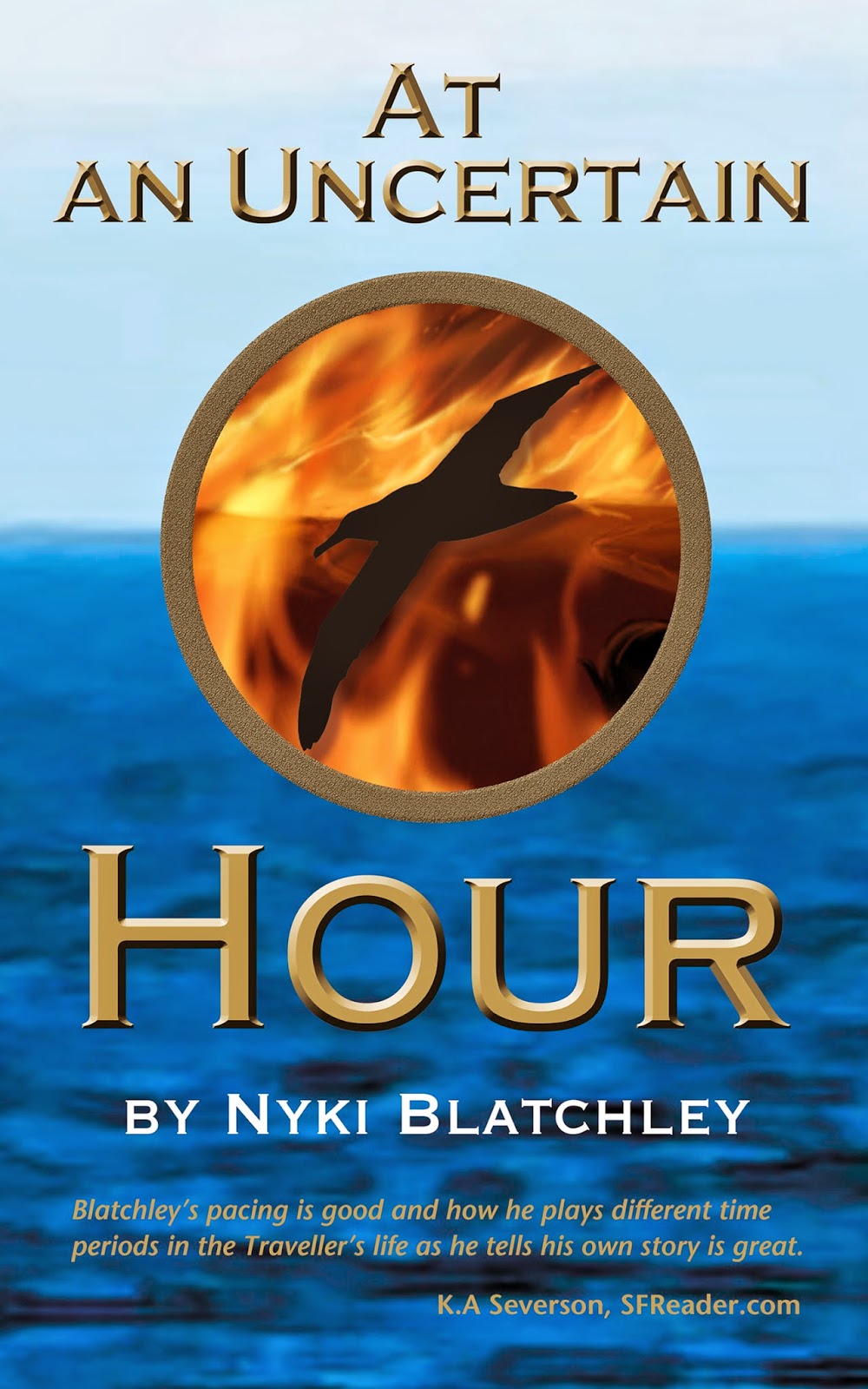
There are positions in between these extremes, and it's also not essential to write an entire story from the same position. In At An Uncertain Hour, for instance, I used the technique of switching between action the main character is immersed in as it happens and memories of his past life, written in a more distant style. I'm by no means the only author who's written like this — check out Iain Banks for a master of the technique.

Third Person


Third person, where every character is referred to as he, she or it, is perhaps the most natural style of storytelling, but it comes in three broad forms: objective, omniscient and limited.

Limited third is perhaps the most popular POV today, although its popularity is maybe exaggerated somewhat by authors and editors. This is where, in any given scene, everything is filtered through one specific person's perceptions and inner thoughts. The greatest sin, if (but only if) you're writing in limited third, is head-hopping, where the POV changes from one paragraph to the next, or even within the same paragraph. Even this can be done effectively, but only if it's deliberately calculated for a specific effect, rather than to make life easier for the author.

The POV may be limited, but that can be handled in a number of ways. It can be deep and immersive, to a point where it's almost indistinguishable from immersive first person, or the "camera" can move out to show us details that aren't being directly noticed by the character. At its shallowest, for instance, you might describe the character's appearance as if from outside — without resorting to the dreaded mirror scene.

That level more or less merges into omniscient, which is where the POV is the author (or at least an authorial presence) who can show us whatever is necessary to tell the story, including the thoughts of multiple characters, general facts about the setting, and pithy comments about life, the universe and everything. It's distinct from head-hopping, though, because the revelations made by an omniscient narrator are made from outside rather than inside, reminding us that this isn't the character telling us what they're thinking, but the narrator knowing it.

The most extreme omniscient approach is the storyteller style, where the author is a direct presence addressing the reader. This is particularly common in a traditional style of children's story, where the author might interrupt the narrative to say something like "I expect you're wondering how he's going to escape from this. Well…"

Occasionally, the omniscient POV can also be a character within the story, usually playing a minor role, who either for specific reasons or just as a device has access to all the necessary information about the story and its setting. This character can be presented as either first or third person.

Objective is superficially a little like omniscient, since the POV is the author, but where omniscient is an active POV, objective is passive. Here, we're only told what can be seen and heard, not what any character makes of it or what they're thinking. Not much fiction is written this way nowadays, partly because it's incredibly difficult to write it effectively (I know, I've tried) but the mediaeval Icelandic sagas3 handled it brilliantly, using it to give a kind of dead-pan insight into the behaviour of the characters by inference, not by revelation.

This doesn't mean that a writer has to choose one of these precise positions and stick with it fanatically. Many writers who use limited third, for instance, will vary the depth from scene to scene, depending on what's needed at the time. Others operate right on the edge between shallow limited third and omniscient, sometime straying to one side of the border, sometimes to the other — the Harry Potter books are an example of this. The key, as with so much in writing, is always to know precisely what you're doing and why. It's possible to make your variations seem natural, rather than careless.

Who Should Be Your POV?


Some stories can be told exclusively through one pair of eyes. This is the default for first person, and many limited third stories also don't need more than a single POV, if the story is about that person. Other stories aren't about any specific individual and need a wide range of viewpoints to show the reader everything that feeds into the edifice the author's constructing.

George R.R. Martin is one of the best-known authors using a POV cast of thousands, but many stories require three or four POVs to cover everything. These POVs (usually in limited third person, though multiple first person novels are found4, and even switching between first and third for different POVs) will change either at the beginning of a new chapter, or else at the beginning of a discrete scene within a chapter. The technique is completely different from head-hopping.

A common piece of advice in choosing which character stands as your POV for a scene, a chapter, an entire novel, is that it should be the person most involved in what happens. That's often good advice, but not always. Sometimes, the person most genuinely involved in a scene, in the true sense, may be standing back and watching events unfold. Someone else may take centre-stage, but this is the person whose motives and assumptions are being challenged by what happens, which will affect their role in the rest of the story.

An extreme case is when the story is most effectively told by an observer, giving us a separate mind to filter the action through. The best-known examples of this are Dr Watson in the Sherlock Holmes stories and Nick Carraway in The Great Gatsby. Though not at all uninvolved, Watson stands a little back and provides us with the eyes to watch the enigma that is Holmes, while Carraway allows Fitzgerald to avoid having to reveal too much about Gatsby.

In the end, the choice of POV — the character, the pronoun used, the limit or omniscience, the immersion or the distance — is all about how to tell the story best, and that will be different every time. As it should be. The point of being a writer isn't to endlessly tell the same story.


1 This caused some problem for Henry VIII's minister Cardinal Wolsey, who grammatically but undiplomatically referred in his Latin letters to "ego et rex" (I and the king). This gave ammunition to those who accused him of arrogance.

2 In fact, there's a little wiggle-room here, since applying that too literally results in the extreme immersive first person style known as stream-of-consciousness — a valid approach, but one that isn't suitable for the majority of first person stories. As long as what you write is more or less in the moment, readers will normally ignore any slight discrepancy.

3 No, the sagas weren't oral tales told round the fire of a mead-hall. They were actually sophisticated literary works, produced by and for a surprisingly literate society.

4 Disclosure: I'm writing one myself at the moment, and finding the process fascinating.

Tuesday, June 9, 2015

"This Is Getting Too Silly," He Expostulated Belligerently

Get a bunch of fiction writers together and there's a couple of things you can be sure they'll eventually start arguing about. One's point of view and the multitudinous ways it can be well used and badly used. The other is the proper way to tag dialogue.

At their most basic, tags are the devices used to show the reader who's speaking, and sometimes also how they're speaking and in what context. The most basic tags are he said, she said, said Ug the Barbarian etc*, but it gets a lot more complicated than that.

For one thing, there are vast quantities of verbs in the English language that mean a particular type of saying, and at one time it was common — certainly more common than now — to use these to the full. Characters would expostulate, opine, or even ejaculate their words.

Generally speaking, this has gone out of fashion. A term has even been coined for it: "said bookisms". In fact, in some quarters you may even be told never to use any verb but said, but that seems to me to be a rule followed off the edge of a cliff.

The argument is that using colourful verbs in tags distracts the reader from what's actually being said, and the manner of speech should be clear from the context. There's certainly a lot in that, but there are other verbs that give a quiet, matter-of-fact account of the speaking, just hinting that the speech isn't entirely neutral — asked, replied, murmured, shouted etc. Each of these can be used without getting in the way of the dialogue itself.

But what about the more elaborate words? Well, it partly depends on the tone you're shooting for. In general, "said bookisms" work better in comic writing (Douglas Adams is an excellent example) but even a more serious writer might want to cultivate an exuberant style that would suit this approach.

As with anything in writing, though, it's important to know exactly what you're doing and why. If you don't have any particular axe to grind, my recommendation is to start with said as your default (perhaps with asked and replied as fairly obvious in their places) and identify the specific places where a more elaborate verb would work. "You'll never get through this gate," thundered Ug has a genuine purpose — said just wouldn't cut it there.

One particularly controversial group of words are those that don’t represent believable speech. I can just about accept laughed or wailed if the person is laughing or wailing a very short phrase. "Stop that," laughed Ug is believable as a phrase caught up in an explosion of barbarian laughter. "That's absolutely the funniest thing I've ever heard in my life," laughed Ug isn't — and not only because no self-respecting barbarian would use the word absolutely.

On the other hand, there are words that don't in any way represent speech — unless you're writing about a species whose language is based on facial expressions — like smiled or winked. I'd definitely advise against these. Instead of "I'm pleased to meet you," he smiled, what's wrong with "I'm pleased to meet you," he said, smiling? Far more accurate.

The other big controversy is the use of adverbs in dialogue tags. Now adverbs tend to have a bad press that's largely unfair, but it's undeniable that a big part of this is because of their overuse in tags. That's not because they're adverbs, though: it's because their use is often a symptom of lazy writing.

Sometimes the problem is that the adverb is vague and could be expressed in a much clearer way. "Stop doing that," she said angrily isn't wrong, but it's not very evocative and "verb adverb" in tags can easily become a very repetitive pattern. Much better would be "Stop doing that," she snapped, scowling. A specific case where I would reach for a slightly more elaborate verb.

Equally, the adverb may be redundant — in tags like she whispered quietly, he asked questioningly, she snapped angrily, the adverb merely repeats what the verb has already told us.

Adverbs aren't always wrong, though. Sometimes an adverb is all that needs to be said. "Is that really true?" she asked quietly is both clear and evocative.

So should we just tag dialogue with an endless string of he said, she said? Not at all. There are plenty of other ways of tagging dialogue, including not tagging it at all. In an ongoing back-and-forth, especially between just two characters, it's obvious enough who's saying what, and it can be given without any tagging at all. As long as you keep track. I've read at least one published book where the author appeared to have lost count in a scene like that.

Or you can use an action tag, instead of a dialogue tag. An alternative to the sentence above, "Stop doing that," she snapped, scowling, might be She scowled. "Stop doing that."

The best approach, perhaps, is to understand the full range of options and use whichever is the right one for the moment, as well as for the bigger picture. Vary the type of dialogue tags, action tags or no tag you use from paragraph to paragraph, and also use tags and interruptions to help the dynamics of the speech**.

Or develop you own non-standard, utterly idiosyncratic approach to dialogue tagging. But, if you're doing that, make sure you do it very, very well indeed.


* When using a pronoun, it has to be she said, unless you're trying to sound archaic with said she. If it's a name or other noun, both said Ug and Ug said are equally correct — it's entirely a matter of taste and how the sentence flows best. If someone tries to tell you (as they occasionally do) that one or the other is wrong, they're talking through an orifice other than their mouth.

** One mistake beginners often make is always to put the tag at the end, even of a very long paragraph. This can confuse readers, if they need to identify who's speaking; it's redundant, since by that point the speaker and the way of speaking should have been established; and it makes the flow of the writing clunky. In general, tags should come early and, if possible, punctuate the dialogue.

Monday, January 26, 2015

What Kind of Characters Do You Write About?

One of the questions an author is sometimes asked (not as often as "Where do you get your ideas from?" or "What's your book about?" *, but sometimes) is "What kind of characters do you like writing about?"

The short answer is whatever characters the story needs, but that's something of a cop-out. Much as we all like to vary our characters, most authors have a tendency to gravitate to some particular kind of character, whether that's a matter of gender, age, personality or lifestyle. So what kind of characters do I like writing about?

One thing I have noticed is that I seem to like writing about teenagers. Not in a YA sort of way, since the perspective tends to be standing a little apart and making gentle fun of the naivety and silliness of adolescence. It's not really a new thing, though. From what I can remember of the stories I was creating at about ten or eleven (none of which have survived) the important characters were always between about sixteen and eighteen — which, of course, was very grown up then, although perhaps young enough to be relatable.

When I started writing The Winter Legend, in my later teens, most of the main characters were still of a similar age, and this has largely survived innumerable rewritings through the decades. And I still use characters of that age a good deal. Estent, the protagonist of The Treason of Memory, is around eighteen, although his age isn't given in the story. Zadith and Musu, in The Lone and Level Sands, are a little older, but not much over twenty, while my recurring characters Kari and Fai (Steal Away, The Temple of Taak-Resh) are around sixteen or seventeen.

Not everyone's that young. The Traveller measures his age in millennia, and the age he "stuck" at is around thirty, but he's in his teens during a number of the chapters in At An Uncertain Hour.

On the other hand, I do like watching characters grow up. The Winter Legend covers about twenty-five years, and the central characters go from teens to early forties, turning from the struggling young heroes to the wise guides, in much the same way that Obi-Wan grows through the Star Wars films.

Perhaps my favourite example of this is Eltava, MC of seven published stories as well as having a cameo in At An Uncertain Hour. In the earliest story I've written about Eltava, Witch, she's fourteen (though I do have flashbacks in a couple of stories to her as a little child), but I've shown her through her twenties, thirties and forties, right through to Storm-Blown where she's in her late sixties. It's been a fascinating ride to watch her growing and developing while still remaining essentially the same person.

In gender terms, although I haven't done a statistical count-up, I suspect I have a roughly 50-50 split, although if anything my first instinct is more often to focus on a female. That's something which has certainly changed through the years. When I was first writing, almost all my POV characters were male, and I deliberately set myself the aim of using more females, but that seems to have become a matter of instinct now.

I'm not sure why this is, but perhaps it has something to do with otherness. Unlike some authors, I don't create characters to explore myself. I prefer to explore what it's like to be someone completely unlike myself and, though I can certainly do that with male characters **, being a female for a story gives the otherness an extra kick.

As for lifestyle, I tend to write about characters who are pretty much footloose wanderers. Perhaps that's an element of wish-fulfilment, since part of me has always been attracted to the idea of being a rootless traveller, although that's balanced by the other part that wonders how I'd lug a thousand-odd books around with me. Perhaps having a very large ship all to myself would help.

The Traveller and Eltava are both wanderers for life, although the Traveller might spend a decade, or even a few centuries, in one place sometimes. Kari and Fai, in their inimitable adolescent style, are homeless, outlaw sorcerers and love every moment of it. Even people with more roots and responsibilities tend to be wanderers, like Ferriji, the protagonist of Present Historic, a middle-aged international diplomat who travels constantly across the world trying to save it from itself.

Other people have wandering thrust upon them, like Estent, who begins The Treason of Memory with a place in his society (quite a high place, too) and finishes it as a homeless exile. In the final part of The Winter Legend (currently finished but by no means finished with) someone from a primitive mountain tribe refers to the difference between those who "stand above the valley and make sure everything [they] can see is as [they] want it" and those who want " to travel to the distance, as I do, and see what’s beyond it." She adds that it's important to have both kinds of people, and I can see her point, but travelling to the distance is more interesting to write about. For me, at least.

So there are a few of the character types I like to write about. I've created all kinds who are utterly different, but, if I switch off and just write by instinct, the chances are I'll be writing about a teenaged wanderer who wants nothing more from life than to discover what's beyond the distance.

 
* Answers: "From the ideas shop round the corner" and "It's about 400 pages".

** I've never been three thousand years old, I've never sailed the world on an enchanted ship, and I've never led an army. Just thought I'd mention that, in case you were wondering.

Sunday, March 9, 2014

Can the Passive Voice Be Used Effectively?

According to some sections of the internet, using the passive voice is roughly equivalent to drowning cute puppies. They revile something that’s been part of most languages for as far back as language can be traced, and which somehow has never gone the way as unneeded distinctions, such as the dual number (to distinguish pairs from singular and plural) or the locative case (a different form of a noun that means you’re talking about where the thing is).

This prejudice is complicated by the fact that a large proportion of people who rage against the passive voice (including one or two professional editors) don’t seem to understand what it is. The common definition is that it’s when you combine the verb with part of the verb to be. That certainly happens in passive, but to give it as a definition is like saying Cows are animals that eat grass is the same as saying Animals that eat grass are cows. Not the same thing at all.

Verbs can be combined with to be for a variety of uses, but the most common, other than passive, is the imperfect or continuous past tense (I learnt the classical names for grammar at school, such as imperfect, but some are rarely used today). This is when you say He was running rather than He ran. It’s another unfairly reviled construction, often misused or overused, but with its proper use. Continuous past is used when you’re describing a process rather than a single act, especially when contrasted with a single act — He was running down the road when he tripped on a stone.

The passive is one of the three main “voices” a verb can be expressed in (there may be other obscure ones, but I haven’t heard of any). Active voice describes the subject doing the verb; passive voice describes the subject having the verb done to it; middle or reflexive voice describes the subject doing the verb to itself.

And that’s about all there is to it — apart from how and why the different voices are used, of course. Though middle should be fairly obvious, so I’ll concentrate on active and passive.

Consider the two sentences Fred hit John and John was hit by Fred. They describe exactly the same action, but they’re saying very different things about it. The first (active) is a sentence about Fred and describes his action of hitting. The second (passive) is a sentence about John and describes his experience of being hit.

In some forms of writing, the distinction isn’t all that important, and other considerations take precedence. The prejudice against passive seems to have started primarily in business writing, and it’s easy to see why. In business, it’s important to come over as positive and active and dynamic, otherwise the predators will tear you to pieces. (No, that’s in the jungle, isn’t it? On the other hand…) If you’re writing a business letter, you need to say I shall do bla-bla, not Bla-bla will be done. Subtle shades of meaning can go hang.

This doesn’t apply to creative writing, though. I could certainly imagine a novel where the author never stops being dynamic and bullish, but it could get tiring pretty quickly. Sometimes a degree of uncertainty and vulnerability add to the story’s tone. In one part of At An Uncertain Hour, for instance, the main character is made a slave for a while. Needless to say, his experience is of being powerless, of having things done to him, and I tried to express this by using as many passive sentences as possible. As he gradually takes back control of his own destiny, the use of passive decreases.

Consider another hypothetical example. You’re reading a story that features a powerful leader, but you get the feeling as you read that there’s something phony about all this strength. Sure enough, you eventually find that he’s a good deal less certain of himself than he seemed. But what gave you that impression? Perhaps the fact that many of the sentences describing him were in the passive voice.

Uncertainty isn’t the only reason to use passive. Sometimes, as with Fred and John, the issue is whom the sentence is actually about, and whether the important thing is to describe the action or the experience of receiving the action. The person performing the action might actually be unimportant, and to say Someone I never saw jostled me gives too much importance to an unknown and irrelevant person. The sentence is about me and my experience of the incident, which makes it more appropriate to say I was jostled by someone I never saw. It reads better, too.

Passive isn’t by any means always correct, of course, and part of the issue is that it’s one of the things (along with adverbs, another bugbear) that inexperienced writers often overuse. That doesn’t mean it’s wrong in itself, though. If you tried to use a hammer to insert a screw, the result would be awkward, but that isn’t the hammer’s fault. It’s the right tool when you need to bang a nail in.

Like most of the absolute “rules” floating around about writing circles, the anti-passive prejudice began with a kernel of useful caution and proceeded via misunderstanding and chinese whispers to a ridiculous restriction that cuts out a whole section of linguistic expression.  By all means, be cautious about using passive, but the solution to the proplem is to learn how to use it properly, not to avoid ever using it.

Passive is often used effectively.

Sunday, November 10, 2013

Write What You Know?

Write what you know.  A maxim regularly proposed by people who don't write to people, especially young people, who want to write.  Possibly the most vilified, misapplied and misunderstood of all writing advice.

On the face of it, it seems like artistic sabotage, especially for a fantasy writer.  Followed literally, it would mean, unless you've had a life like Jack London or Joseph Conrad, all most of us would be able to write would be little, slice-of-life tales of social realism.  Not that there's anything wrong with stories of that kind if they're what interests you, but it isn't what all authors want to write — and, more to the point, it's not what all readers want to read.

It's especially bad advice to give a child who wants to write.  Again, the child might genuinely want to tell a story of someone of their own age going to school and living the same kind of life they do, but most will want something more exciting to write about.  In any case, the worst possible thing to do to a child-writer, or any child, is to clip the wings of their imagination.  Their work's highly unlikely to get published, whether they write school stories or improbable tales of international espionage, and it's far better for their future enthusiasm if they have fun doing it.

The literal interpretation would certainly rule out any fantasy.  How can anyone write about immortal sorcerers, wandering swordsmen or swordswomen, meetings with gods or commanding vast armies if they write only what they know?

But that's not all there is to it, of course.  Write what you know is possibly the worst-phrased maxim to mask genuinely good advice.

What lies behind it was expressed beautifully by the Anglo-Irish writer Lord Dunsany, who in the early 20th century virtually invented the fantasy short story as we know it.  Dunsany wrote exotic tales of Elfland, the edge of the world and the lands that lie beyond the fields we know, but he considered:

It is my belief that those sudden visionary pictures which are the true essence of any art arise like a flower from a seed that has fallen into the mind, sometimes in infancy, sometimes in later childhood, sometimes in adult years, but often as imperceptibly as any seed blown on the wind finds a home for itself in the earth at the end of its wandering.  Bricks without straw are more easily made than imagination without memories.

Half a century later, another great writer, Bob Dylan, said it more succinctly and far more colloquially:

Open up yer eyes an' ears an' yer influenced
an' there's nothing you can do about it

My own favourite image of this process is a vast cooking-pot.  Into the pot goes everything that happens to me, everything that happens around me, everything I hear about, every item from the news, everything I read, watch or listen to, everything I think or discuss with other people.  The pot simmers constantly over the heat and I stir it regularly.  When I write, I dip in a ladle and take a spoonful out.  Everything I threw in is there, but changed, blended into new forms and new combinations that bear little resemblance to the raw ingredients.  This is the stew that makes my stories.

So how does this work?  In At An Uncertain Hour, I had to write about a character who reluctantly takes on commanding the army of a great alliance for a thousand years to defeat an evil empire, even though what he really wants to do is wander the world on an enchanted ship.  Strange to say, I've never actually done any of that myself.  Hardly writing what I know.

On the other hand, like most of us, I've had to choose between fulfilling moral and social obligation and letting myself drift along doing what I love.  I've had to square up to taking on positions of authority — not commanding a vast army, but managing people at work or running performance clubs — in spite of doubts about whether I'm really a natural for it.  I've fulfilled duties while dreaming of being free and footloose.

In addition to this, of course, I've observed many other people in positions of authority (often over me), followed the news about public figures, read works of history and biography about great leaders and generals of the past.  All in all, I'm surprisingly qualified to write about this character.

The things we know above everything else are our feelings and emotions, and these are what we tap into and extrapolate to experiences we've never known and are never likely to know.  Suppose your character is being hauled before the King, wondering whether the sentence is going to be instant execution.  It's not only unlikely that this has happened to any modern writer — it would also be highly inadvisable to attempt to seek out the experience. 

On the other hand, you might well remember sometime having been called in to see the boss, wondering just how much trouble you're in, terrified that you're going to be out on your ear.  Resurrect that memory and remember just how you felt; then expand and transfer it, try to feel those emotions again but much, much more intensely, and apply them to how another person might feel.

Imagination = experience + extrapolation + empathy.  As simple as that.

All right, it isn't really simple, but it's a start.  Of course, there are practical issues as well: things a writer might simply not know.  I recall long ago hearing a writers' cautionary tale.  A sheltered Edwardian lady wrote a novel in which her hero went to an Oxbridge college and ended up rowing in the University Boat Race.  Now, the whole point of a rowing team is that they have to learn to keep in perfect synchronisation, otherwise chaos ensues; but this author, in her enthusiasm, wrote a sentence something to the effect of Everyone rowed fast, but {the hero} rowed faster.

The moral of the tale was supposed to be that she'd no business writing about something she had no experience of, but I take a completely different moral from it.  If she wanted to write about the Boat Race, fair enough, but she should have got hold of a good book about rowing techniques and read it cover to cover.  Ideally, she should also have found a nearby rowing club and gone to watch practice there.  Perhaps talked to some of the rowers (shocking for a nice lady, but she could have taken a chaperone) and memorised some of the phrases they used and the experiences they'd had.  That would have enabled her to write the episode not only without that obvious blunder, but with a depth of involvement that made it seem she must be an expert rower.

We're living in an age where, compared with that Edwardian lady, we have any information we need just the click of a button away.  It's not always quite that easy, of course, but we really have no excuse but laziness for not researching the things we put into our stories.

Anyway, research is fun.  It's an opportunity to learn things, gain new experiences.  It might even take our lives off in rich, unexpected directions.  At worst, it'll stand us in good stead in trivia quizzes.

Write what you know?  Perhaps it's time to abandon that misphrased saying and the inadvertent damage it can do, and bring out in its place the true meanings that it masks.  Write what you feel.  Write what excites you.  Write what you want to know.

Saturday, September 14, 2013

Sisters & Cousins & Aunts: Language Families for Fantasy Writers

Last year, I posted Fantasy Languages for Dummies here, where I outlined some of the basic issues to think about when inventing words and names for an imaginary language.  Judging from the number of hits, it seemed to be something that interested a lot of people, and I thought I'd try something a bit more advanced, for those who want a little more out of their fantasy languages.

Most fantasy writers who create a secondary world invent imaginary languages to some extent, even if it's only a handful of names.  Some, of course, stick strictly to real-world languages, but most have something invented.  In many cases, these don't offer any consistent sense of phonology or morphology, but there's usually a hint of it, even if it's only the Burroughs Universal Constant (that, wherever you go in the universe, female names always end in a).

Writers who take a genuine interest in language and naming, though, might put a lot more thought into the matter, creating names that follow similar linguistic forms when they come from the same culture and distinct forms when they don't.  Well and good; but few fantasy writers (unless they happen to be linguistically orientated professors of English from Oxford) seem to consider how their various languages relate to one another.

Languages don't exist in isolation.  Well, OK, some do, like Basque or Burushaski, but they're exceptions.  We'll come to that later.  Most languages, though, are grouped into a hierarchy of families, super-families, super-super-families etc. in structures so similar to biological taxonomy that the same terms are often used, though not consistently.  English, for instance, is a Low German language, belonging to the West Germanic division of the Germanic family, part of the great Indo-European phylum.

What exactly does that mean, though?  Everyone knows that English is essentially a rag-bag language that contains French, Latin, Celtic and Greek, as well as words from almost every part of the world the British Empire ever came into contact with.

There's an easy experiment that can show what the classifications mean.  Well, easy to imagine and explain: not quite so easy to do.  Take an average passage of English (not too scholarly or technical, not too monosyllabic) and list every word in it.  Then look up the origins of those words (a good dictionary would give that) and count how many words derive from each source.

What you're likely to find is that the great majority are either Germanic, whether from Anglo-Saxon or Scandinavian, or Latin, whether directly or via French.  There'll be a smattering of Celtic and Greek, together with odd words from further afield.  The balance of Latin and Germanic will probably be roughly even, maybe with more Latin words. 

So why isn't English counted as a Latin language?

Now repeat the experiment, but counting each word each time it occurs, and you'll find a dramatic change, with the vast majority derived directly from Anglo-Saxon.  This is because the Anglo-Saxon vocabulary of English includes the most common words, repeated over and over: the, and, to, for and so on.

This is what linguists mean when they classify a language as belonging to a family, and it's easy enough to see why.  Vocabulary changes all the time in a language.  It's not hard to imagine foreign words for, say, house or table becoming fashionable and eventually replacing the original words, but why would anyone create a different word for the?  These words do change, of course, but very slowly and usually only in ways that can be easily followed.  That makes them a breadcrumb trail back to where the language has come from.

Languages drift apart when two groups of speakers don't often interact.  They borrow different foreign words and coin different words for new concepts, but their pronunciation often diverges quite radically.  Pronunciation is changing all the time.  It's true what the old people say: youngsters don't speak the way we did at their age.  Of course not; and, over the centuries, it can become completely different, till a linguist comes along and explains how it's really all related.

There's a saying I remember hearing long ago: when comparing languages, vowels count for nothing, and consonants for very little.  That's not quite true, but you have to understand how the different letters are formed to understand why one can change into another.  One of the most famous sets of changes is known as Grimm's Law (yes those Grimms — they were primarily linguists) which explains how the Germanic languages differ from other Indo-European groups.  For instance, the English word foot is actually the same word as the Latin equivalent, whose stem is ped (as in pedal).  Under Grimm's Law, p mutates into the related sound f, d into the related sound t, and the vowel just mutates.

It goes further.  During the 1st millennium AD, the Western Germanic dialects divided into High German and Low German (that's not like High Elvish, by the way, just a matter of whether they were spoken on the upper or lower Rhine) and foot in Low German (which includes English and Dutch) became fuss (the vowel's pronounced much the same) in High German, which is modern German.  Similarly, in many cases d again turned into t — door/tur, deer/tier etc.

These might seem small changes but, with large numbers of them going on over thousands of years, together with word replacement, languages that started almost the same can change beyond recognition.  In a context without a strong, centralised political or cultural structure, this will take a form where the language spoken in village A and village B diverge a little, although not too much for them to understand one another.  Similarly, the villagers in B won't have too much trouble understanding the speech in village C, but those in A might struggle a bit.  By the time you reach village Z, there appears very little similarity at all.

If, on the other hand, there's a strong state that needs to issue laws and proclamations that will be understood, or if authors and poets are writing works that are understood to be expressions of the entire culture, standard forms will gradually emerge that become national languages.  These often differ little from the language next door, but their speakers like to think of them as different for political or religious reasons: Dutch/Flemish, Serbian/Croatian, Hindi/Urdu, Malay/Indonesian etc.  Curiously, with English and American, which are almost as distinct as some of those pairs, the political separation seems to have fostered a sense of being a common language, instead.

Many of the world's languages are grouped together into widespread super-families — examples include Indo-European, Afro-Asiatic, Altaic, Sino-Tibetan, Austronesian and Niger-Congo, along with many smaller families.  In the New World, the old picture of a dozen or so families has been brought down (though with disagreement from many linguists) to three, with the Amerind family covering all of South and Central America, much of the contiguous US and eastern and central Canada.

The temptation is always to try to link up language families into fewer and larger super-families, but that's not always easy.  Indo-European is a relatively straightforward case, and even that produces controversy and disagreement. 

It's a special case for two reasons.  One is that it's a relatively young family.  Although there are different models for its origin, it's probable that it descends from a group of mutually comprehensible dialects spoken between four and five thousand years ago.  The other is that it includes languages (such as Greek, Latin and Sanskrit) that were extensively written more than half that time ago, and some, such as Hittite, that have left written records from when the family was fairly young.  This makes it quite easy to establish what it was that all these languages are descended from and so identify other members of the family.

On the other hand, many language families are significantly older, and their languages have sometimes only been written down for the first time within the last few centuries.  This makes identifying their relationships even more difficult, especially when they're isolated remnants of families that have largely been replaced by a later wave, a process that's still going on, especially in areas of the world that were colonised by Europeans.  Isolated languages like Basque in the Pyrenees, Burushaski in Kashmir, or the so-called Paleo-Siberian languages may not have had any interaction with any "relatives" that might survive for ten thousand years or more.

Some languages are more conservative than others (Lithuanian, for instance, is often taken as the closest we can get to how the original Indo-European language might have been) but ultimately they all change, mutating their sounds and replacing their vocabulary with foreign imports.  There's a point beyond which current techniques just aren't good enough to detect whether two languages are related or not.

Besides, associations can be as important as "descent", as we saw with the huge quantity of imported vocabulary in English.  Sometimes these influences are greater, affecting even the structure and the stable words used by linguists.  For a long time, there was a controversy over whether Vietnamese was a Kadai language, like its neighbour Lao, or an Austroasiatic language, like its neighbour Khmer.  Most linguists have plumped for the latter, but the language is very much a hybrid.

Japanese is an even stranger case.  The jury's still out here over whether it's an Altaic language that arrived via Korea or an Austronesian language that arrived via the Philippines.  It displays elements of both.

So it's unlikely that we'll ever know for sure whether all human languages ultimately derive from the same source, or if they arose independently in many parts of the world.  The human brain appears to be hard-wired for language, so the multiple invention theory is quite plausible.  It's likely to come down to when our ancestors started talking.  Until quite recently (the idea appears in Pullman's His Dark Materials trilogy) it was believed that language started with a quantum leap in human intellect as recently as 33,000 years ago, at a time when the species was already spread all over the planet, and that would have favoured the multiple origin of language.

Recently, though, both circumstantial evidence of earlier symbolic thought and physical evidence of a speech-enhancing mutation of the larynx have suggested that humans were using language a great deal earlier, probably at a time when they were confined to a relatively small area of Africa.  Although this doesn't prove the single-origin theory, it makes it much more likely.

Then again, maybe they were all taught by Quenya-speaking elves.  It's possible.

So what bearing does any of this have on writing fantasy?  Unless you're going to actually create a whole raft of languages, and then treat your readers to a lecture about them, does it really matter what families they belong to?

Well, yes and no.  It's very much a background aspect, which the reader's unlikely to notice (though it may be far more noticeable if it's ignored or poorly done) but it can contribute to that seamless gloss of reality that the best fantasy worlds somehow achieve.  World-making always reminds me of a swan: seeing it gliding gracefully and effortlessly across the water gives no idea at all of how its legs are going nineteen to the dozen underwater to achieve that impression.

The sounds and elements that make up names can give away subtle relationships between their countries' languages.  Suppose, for instance, several towns in your main country have names ending in -ket — perhaps this is the equivalent of the English element -ton.  Another country (three or four across, perhaps) has a town whose name ends in -gad.  This could suggest the same kind of sound-shift as those described by Grimm's Law, indicating the two countries have related languages, but not closely related.

It can also affect the difficulty characters encounter when learning to speak foreign languages.  It tends to be easier to learn a language if we can latch onto familiar elements and harder if nothing's alike.  I have a scene in an unpublished novel where a character who's good with languages is trying to learn to speak to the people he's staying among.  He comments that it's easier to learn than many, observing that Some of the words seem a bit like Kimdyran.  Like, they say duvin for a cow, and we say tovien.  On the other hand, he tries and totally fails later to learn another, very strange language.  Besides giving an element of his character, it helps to define the relationships between languages, and therefore cultures, within his world.

On the principle that "messy worlds rule", this doesn't have to be too predictable.  In our world, even before languages like English, Spanish and French went global, some language families were extremely far flung — Austronesian, for instance, is spoken all the way from Madagascar to Easter Island, and is mixed up in places with other families.  On the other hand, bordering countries may be linguistically unconnected, such as Hungary, forming a Uralic island in a sea of Indo-European Slavonic languages.

You can perfectly well ignore all this.  Most authors do, I suspect, and often still manage to produce worlds with believable names and cultures.  It can give an extra layer of reality, though, to think about how your languages relate to one another.  And, if you're like me, it's fun.  Which is the main thing, of course.

Sunday, September 1, 2013

Repost: Ten Writing Rules to Take with a Grain of Salt by E.L. Wagner

An excellent new post on E.L. Wagner's Umbral Musings blog debunks some of the "rules" that are flung around for writers to follow.  This is a great selection of such rules, and a fine explanation of how, even though most (though perhaps not all) have some basis in reality, they all need to be taken with a grain (or even a large bag) of salt.

You can read her post here.

Saturday, August 10, 2013

Stephen Trotter - The First Story I Wrote

Something authors occasionally do on their blogs is to post the first story they wrote, and I decided to follow suit.

I remember the occasion.  It was a hot summer's day, and my grandparents had put a table and chairs out in their garden for the kids to write or draw on.  I had what was meant to be a drawing-book, but I decided to write a story instead, as well as illustrating it.  I was four years old.

This was the first of several stories I wrote about a horse called Stephen Trotter (or stephen-troter, as I originally called him) who for some reason wore a suit and top-hat, before moving on to more ambitious tales.  My brother (three years older) insisted on "correcting" what I'd written, but I still prefer my first draft.

I think many of the themes I've used since — independence and responsibility, aspirations, the abuse of power — are latent in this story (so latent that they're invisible) but my narrative technique and characterisation have definitely developed since the age of four.  And my spelling's slightly better, too.

I've also reproduced one of my illustrations for the story (Stephen and the man with the teliscop).  I think this is an important picture, showing as it does my wisdom in concentrating on writing rather than art.


once apon a time there was a Horse called stephen-troter and he pulld a cart and his driver was called Joe.

one day he was pulling his cart along when they met a man with a teliscop in his hand. and the man said stephen coued look throo the teliscop so stephen looked throo it. and he turned the teliscop upwaeds toords the sky and what does he see he sees a parashootist coming down and then he said I wish I coued fly in that Aeroplane said stephen.

Never Mind said Joe phaps we can hier it.

and then they saw the parishootists had nealy reeched the ground. stephen shook hands with the parishootist. and then they hiered aeroplane and had a ride in it.

and then they went Home and went to sleep.

Monday, July 15, 2013

Evolution of a Villain

When I first began to consciously write epic fantasy, in my mid-teens, the villain of my story, The Winter Legend, was the obvious type of Dark Lord, threatening to conquer and oppress the world for no very apparent reason.  That's part of the standard Dark Lord job description, after all.  He was a little different from most, since he was referred to as the Winter Lord, and his primary aim was to spread winter everywhere he conquered, though I imagine that wasn't entirely uninfluenced by the White Witch of Narnia.

At first, this Winter Lord, who eventually acquired the name Kargor, had little presence as a character.  Like Sauron, he was a distant menace, seen in occasional distant glimpses, but mostly by the effects of his oppression.  When he finally made a direct appearance, though, he pretty much ran the gamut of Standard Dark Lord Behaviour, insulting and abusing enemies and minions alike.  I think I resisted having him cackle, but little else.

Not that the character was entirely generic — I did put some thought into the psychology.  Kargor has a flame (now called the Tryst Flame, though it was unnamed back then) which ensures his invulnerability, and I did somewhat develop the duality of the confidence and the paranoia this gives him.

Nevertheless, there was little originality about him, even though the heroes (male and female) were evolving nicely from idealistic action junkies into vulnerable, reluctant heroes.  Fortunately, the version I wrote in the late 70s failed to interest publishers, and when I finally came back to The Winter Legend, ten years later, I'd evolved enough as a writer and a person to rethink my villain.

There were two main problems.  Well, three, counting the simple fact that the character was just plain clichéd.  The first was that I had another, more minor villain, a mortal king, who was almost exactly the same.  There was actually more justification with this character, Jekaini.  For one thing, he was very much in the tradition of rulers who are delicately balanced between insane and psychopathic — my original idea for him was a kind of mash-up of the Emperor Caligula, Adolf Hitler and Idi Amin.  For another, he only makes a couple of brief personal appearances, and the main point about him is the effects of his personal and political tyranny, especially on his children.  This worked well enough, but I didn't want two such similar villains.

The other problem was a more practical issue.  When we first meet Kargor, he's only recently been defeated and exiled, yet within a year he's established a kingdom and gathered a large, loyal following.  While minions might take abuse from a successful leader whose power they hope to share, why would anyone follow a powerless exile who clearly doesn't value them?

The revised character who emerged from my cogitations was very different: pleasant, charismatic, cultured and genuinely loyal to his friends and followers, yet still vacillating between confidence in his invulnerability and morbid terror of what might happen to him if he were to lose this.  Kargor's overwhelming concern is his own safety, and it's this obsession — treated very much as an addiction — that leads him conquer and commit atrocities.


As he develops through The Winter Legend (and as he'll be presented in the prequel I intend to start work on soon) Kargor shows every side of his character, from the personable man who adores his friends and is adored in return to the frightening image of someone who's willing to sacrifice anybody, however special they are to him, in order to ensure his own safety.

He also gives some hints of his earlier life, and the circumstances that led to the obsessions and grudges that drive him.  I've recently begun writing stories about that very young Kargor (then called Karaghr, or Kari) and his girlfriend Failiu.  Two largely clueless teenagers dabbling in sorcery they don't fully understand, they are charming, amoral and driven by insatiable curiosity as they wander through their world.  Nevertheless, in these stories (including The Temple of Taak-Resh) Kari and Fai are the people the reader's meant to root for, and I find it fascinating to explore this very different side of my villain.

It's been largely through this process that I've discovered a simple fact which, however many older and/or wiser people might tell us this, each author has to discover for themselves — that villains, like heroes, are nothing more or less than people.  They may be people we admire or people we hope we'll never encounter, but people.  It's when we let go of thinking about the creation of a Villain that we can finally start creating genuine villains.


Wednesday, May 22, 2013

End of an Epic?

Forty-four years ago, while I was still at school, I had an idea while I was taking our dog for a walk in the country.  The title The Winter Legend came into my head, followed by elements of a story it could go with, about the downfall of an evil sorcerer called the Winter Lord.  I didn't want to go home till I'd got it well enough worked out (my home environment was supportive to reading and writing, but there were always distractions) so the poor dog was exhausted by the time we got back.

I began writing it as a series of ballads, but I abandoned that, partly because I realised that there was a whole earlier section to the story, and started writing it as a blank-verse narrative — I abandoned that, too, after about 2000 lines.  A few years later, I wrote a proper prose novel version of the whole first section, but I didn't go any further.  This was partly because no-one showed interest in it (and, looking back on how it was written, I'm not surprised) and partly because, though I knew what should be in the first and third parts, I only had a very vague idea of how to link them.

I wrote other things, including a number of stories set in the same world, which extended it in both history and geography, but eventually returned to The Winter Legend about ten years later and rewrote the first part, now called The Tryst Flame.  Besides general writing quality, I made a number of improvements, most notably changing the main antagonist from a cardboard pantomime villain into a more interesting character.

I immediately followed that with the second part, Children of Ice, having realised what story it needed to tell, but came to a halt again after that.  This version, too, was failing to impress anyone and, as the rejections came in, I began to understand why. 

Anyway, I got distracted, becoming intrigued by the backstory  I'd given to one of the supporting characters.  I started writing stories about the Traveller, extending the world by thousands of miles and thousands of years, and the main backstory I'd created became the basis for my novel At An Uncertain Hour, published in 2009.

In the mid-00s, though, I decided I was going to go back to The Winter Legend and make a concerted effort to get it done.  I wrote new versions of the first two books and then started writing the third, Dreams of Fire and Snow (it was originally going to be Songs of Fire and Snow, but some guy called George got there first — serve me right for not using ideas when I have them).  This was odd, because I was now using the plot elements I'd come up with on that walk for the first time since the ballad versions, although they'd mutated almost beyond recognition.

I got about three-quarters of the way through and came to a grinding halt.  There were various reasons, I think.  The story had developed a good deal since I'd started, and I found I'd written myself into several corners that would need some thought to get out of.  Beyond that, though, I think I was a bit scared of actually finishing this thing that had been a work-in-progress for most of my life.

So I wrote more about the world, extending it even further.  My novella The Treason of Memory, for instance, is set at a later period after the discovery of gunpowder, while a forthcoming story, The Flowers of Kebash, manages to link its neolithic and computer ages.

About three years ago, though, I came back to The Winter Legend.  I revised The Tryst Flame into submittable form, and did a more radical revision of Children of Ice, before finally returning to Dreams of Fire and Snow earlier this year.  I'd worked out how to fix the plot holes (more or less) but, instead of going back and changing them, I ploughed on to the end, simply retconning several issues and marking them to be changed in revision.

On Monday, I wrote the final words of the epilogue.  For the first time in forty-four years, I have a complete version of The Winter Legend.

It's a strange feeling — partly elation and partly bereavement.  I've felt that to some extent when I've finished novels before, something almost like postnatal depression (not that I'd seriously compare it to the traumas some women go through for that) but it's far stronger this time.  I think I understand why Tolkien never finished work on The Silmarillion, which he spent nearly sixty years writing.

Of course, I haven't finished with The Winter Legend.  The Tryst Flame is currently doing its best to impress the good people at Harper Voyager, but I have revision to do on Children of Ice and a lot of revision on Dreams of Fire and Snow.  And then I'll have (I live in hope) extensive copy edits and line edits to work through on all three, till I'm sick of the whole thing.  But that's all just tinkering, if on a large scale.

And what then?  Well, I have a novel ready to go that's a sequel to At An Uncertain Hour and a prequel to The Winter Legend — I'm using The Empire of Nandesh as its working title, though there's almost zero chance that'll be the title it'll finish with.  Then there's a trilogy set a couple of centuries later, and a further novel to finish off the whole process, though hopefully that won't be the end of my exploration of the world all these are set in.  And I have unrelated projects, too.  My Sam Nemesis stories have been well received, and I have several more ideas, and I also have another world, which uses magic technology, I want to develop further.

But The Winter Legend has been the central pillar of my imagination since childhood.  Besides the story itself, it's given me a world of seven continents and ten thousand years as a playground, and my most successful recurring character, the Traveller.  I feel both proud and scared to have finished it.