Showing posts with label The Lone and Level Sands. Show all posts
Thursday, January 15, 2015
Fantasy and Archaeology on the Musa Publishing Blog
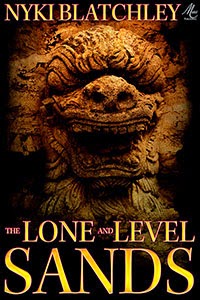
I feature today on Musa Publishing's blog, discussing links between fantasy and archaeology, especially in my new Musa ebook The Lone and Level Sands:
Fantasy and archaeology — they seem made for one another, don't they? After all, one of the most common ideas in fantasy is someone discovering ruins or a lost artefact from an ancient civilisation, yet real archaeology is very underused.
As an approximate concept, of course, it's always been there. The spectacular discoveries of the 19th century, when entire civilisations were being uncovered — what's been called the heroic age of archaeology — inspired authors like H. Rider Haggard and many others to write stories in which explorers found such civilisations not just as ruins to be dug up, but actually still surviving... read the whole piece here
Saturday, January 3, 2015
2014 and 2015
Another new
year already. Traditionally (by which I mean for the last two years, which
seems to qualify as a tradition these days) I start the year by reviewing my
writing achievements over the year that's finished and looking ahead to the
year to come.
During 2014, my
writing has been somewhat disrupted by… well, by writing. Since March, my
official day-job has been as a freelance copywriter, and the work I've needed
to put into building that up — which seems to be paying off — has severely cut
into my creative writing time. Still, among all that, I seem to have got
through a fair amount.
I'm not as far
as I'd hoped through my current novel (working title The Empire of Nandesh) but I'm more than 50,000 words into it. I'd
been hoping to be nearly finished by now, but both the copywriting and other
projects have cut into it. I revised the novella The Dweller in the Crack, and wrote three shorter pieces, Finder's Fee, Turning the Tables and Gerda and the Darkness, but the biggest
distraction was my very unexpected diversion into children's fantasy.
A few years
ago, I wrote a very short piece called The
Biggest Dragon in the World, which featured a sorceress called Cariana. I
really wrote it for my own amusement, but it turned out as a children's story.
During the summer, I attended a workshop of mainly children's authors and took
the story along as my one qualifying piece. They loved it and encouraged me to
expand it into a series.
I've now
written half a dozen other connected stories, but the series took an unexpected
turn when, in the second story, I introduced Cariana's nearly-eleven-year-old
apprentice Flea, who's taken over as the central character. I'm having huge fun
writing about her — in the most recent, she has an encounter with pirates — and
the aim is to add perhaps three or four further stories and then, after
revision, try to pitch it as a book.
I've begun
self-publishing some of my out-of-print work, which has been an interesting
process. I have mixed feelings about self-publishing, but it's a valuable
option for an author with the experience and willingness to put in the work it
needs. So far, I've republished At An Uncertain Hour, the novel previously issued by StoneGarden, and Steal Away, the first story about
Karaghr and Failiu, which first appeared in the late, lamented Golden Visions.
I'm also hoping to bring out the sequel, Rainy
Season, also a Golden Visions story,
and perhaps others.
As far as
professional publication is concerned, December saw the publication of my
second ebook from Musa Publishing, The Lone and Level Sands. A contemporary (or nearly contemporary) fantasy but
set in a secondary world, this is archaeological fantasy somewhat in the
Indiana Jones tradition. It came out just before Christmas, so I'm gearing up
again to restart promotion.
Besides these,
I've had stories in The Colored Lens (Damned) and Plasma Frequency (The Lady of the House and The PetrologicEngine, the latter my "flintpunk" story) as well as in three
anthologies, two of which I was involved in producing. Light of the Last Day was the somewhat overdue anthology from
Fantasy-writers.org, which I co-edited and contributed Lari's People and Dayglow,
while the equally long-in-making The Tale Trove is the first production from my live writers' group, the East Herts Fantasy Writers. My contributions are Return
Switch, Hanuut's Stand, I See a Voice and three poems. I've also
appeared in Unburied Treasure, a
follow-up to last year's Trespass,
with the custom-written Finder's Fee.
So what of
2015? I'll probably continue to have less time to devote to writing than I did
before last year, but I have The Lone and
Level Sands to promote, and I hope to reissue Rainy Season this year. On a slightly longer-term basis, I've been
considering self-publishing a collection of stories about Eltava. All but two
have been published in various markets, and all rights have now reverted to me,
so it might be a practical option. But a lot more work than putting out single
stories.
I'll continue
with both The Empire of Nandesh and the Flea stories, and hopefully I'll finish
the draft of the former and have the latter ready for submission during the
year. That's assuming I don't get diverted again. We'll see.
I'd like to
wish you all a very Happy New Year.
Sunday, December 21, 2014
The Lone and Level Sands - the lost scene that began it all
For some years now, I've belonged to a group of online authors who get together once a week and all write for exactly an hour on whatever topic one of us sets. The object is to get us writing fast and with as little internal editor as possible, but the results are sometimes (though not always) gratifying. Many stories that started that way have been published, including no less than eighteen of mine. Some have been flash fiction that I completed in the hour and polished later. Others have have fragmentary beginnings that I've expanded into longer stories. My previous Musa book, The Treason of Memory, was among those which started that way.
Back in 2008, in response to the prompt "write a story about an object being dug up from the ground which radically alters your character's conceptions of the origins of something", I wrote what would eventually turn into The Lone and Level Sands. However, this wasn't the beginning of the story that Musa has just published, but a scene that takes place months earlier and in a different country.
For anyone who's curious, I give that original scene below. I've changed nothing, even keeping the different spelling of the main character's name. I've no idea whether the decision to change Zaddith to Zadith was deliberate or a typo, but he's unmistakably Zadith now.
And that's where the hour finished, just when the scene was getting interesting. Kebash was a name that had come up here and there in other stories I'd written set in the same world, as an ancient, lost city that was the source of the most dubious magic. A kind of equivalent of Atlantis with a darker reputation.
I knew I wanted to write a full story based on this scene, but how? When I started thinking about the plot, it was very obvious that the story proper had to take place during the dig itself, and the later in the dig the better. This could serve as some kind of prologue, but that would feel awkward.
In the end, I made a fresh start, with the dig in full swing and Zadith and Musu (who had now acquired a diminutive of her name) watching the army trucks approaching across the desert. There was no place for this scene, although it is referred to in the story, and several of the points of discussion appear in a different context.
The Lone and Level Sands is, as it should be, a far more centred story, both in time and place, than would have been possible if I'd used this scene. But this is where it started, in terms both of the main characters and of the search for the Temple of Shetti and evidence of Kebash.
The Lone and Level Sands and The Treason of Memory are both available in all ebook formats from Musa Publishing.
Back in 2008, in response to the prompt "write a story about an object being dug up from the ground which radically alters your character's conceptions of the origins of something", I wrote what would eventually turn into The Lone and Level Sands. However, this wasn't the beginning of the story that Musa has just published, but a scene that takes place months earlier and in a different country.
For anyone who's curious, I give that original scene below. I've changed nothing, even keeping the different spelling of the main character's name. I've no idea whether the decision to change Zaddith to Zadith was deliberate or a typo, but he's unmistakably Zadith now.
“And
these were dug up where, exactly?”
Professor Thalidri sipped his drink with the prim delicacy Zaddith had
always found absurd in such a big man, peering over his glasses at the two
graduate students before him.
“In
the desert,” said Museve eagerly, evidently not noticing the corroding
scepticism in their teacher’s tone.
“Twenty miles from the coast, near Lahlem. There’s a theory...”
“Thank
you, Ms Amwa,” the Professor interrupted, and for once the young woman fell
silent immediately, her shoulders drooping a little. “I assume you’re referring to the theory of
the temple of Shetti. I can assure you,
it was a theory popular among the more... enthusiastic of students when I was
your age. I see that little has
changed.”
“But,
Professor.” Zaddith usually let his
friend do the talking, but he couldn’t contain himself. “Surely this is evidence. The fact that tablets like these have been
excavated just where the temple’s supposed to be... Well, it’s evidence, isn’t
it?”
“Thanks
for your usual incisive analysis, Mr Zaddith,” said the Professor dismissively.
Zaddith
squirmed in embarrassment and annoyance.
Though his papers always received top marks, he somehow couldn’t
reproduce the same fluency in speech, and he’d learnt to keep his mouth shut in
class, for fear of ridicule.
The
annoyance was because he knew that Professor Thalidri was perfectly aware that
his surname came last, not first as it did here in Qymssa. He didn’t make the same mistake with Museve;
but Zaddith had long since realised that the Professor disliked Northlanders
and took that dislike out on him.
“Professor,”
said Museve, her tone more conciliatory, “you must agree that it’s a
significant find, whether the temple exists or not.”
Three
pairs of eyes returned to the baked clay tablets strewn on the desk between
them. Zaddith and Museve had taken a
risk smuggling them out of Hranti, one of the more unstable of the petty
dictatorships that clung to existance in the Sruq Desert. Officially, they risked prison for removing
antiquities without a licence, but Zaddith suspected that they could very
easily have been shot in secret, to become just two of the many people who’d
vanished in Hranti over the past decade.
In
the end, though, neither could bear the thought of spending months, even years,
applying for a licence, maybe to be refused in the end. Zaddith was still having nightmares at the
thought of what might have happened, but they were clear.
“The
script is clearly similar to Early Dembin,” commented Thalidri at last, less
scornful as he immersed himself in the ancient texts. “The language, though...” He paused a moment, sounding out some of the
symbols. “It has certain structural
similarities to proto-Sriwali, and... yes, some vocabulary in common too, I’d
say. Perhaps an extinct language from,
oh, let’s say, four thousand years ago.”
The
two students glanced at one another, and Zaddith wondered whether Museve would
have the nerve to bring up their theory.
“We
thought so too, at first,” she said, a little uncertainly. “But there are elements that don’t appear to
be Sriwali at all. I... we think it may
be an older language. We think it’s the
language of Kebash.”
There
was a long silence, while Zaddith waited for the Professor’s sardonic laughter;
but it didn’t come. When he looked up,
he saw that the older man was staring at them.
“Kebash.” There was no inflection as he spoke the
name. “Are you trying to claim you’ve
found the lost city of Kebash?”
Museve
took Zaddith’s hand under the desk, clearly for support, and gulped. “Not... not actually,” she said at last. “The stories all talk about Kebash being
overwhelmed by the sea as punishment for its sins, not buried in the
desert. But... the tradition is that
Kebash was somewhere between Xeinnur and the mainland. Couldn’t this have been an outpost?”
And that's where the hour finished, just when the scene was getting interesting. Kebash was a name that had come up here and there in other stories I'd written set in the same world, as an ancient, lost city that was the source of the most dubious magic. A kind of equivalent of Atlantis with a darker reputation.
I knew I wanted to write a full story based on this scene, but how? When I started thinking about the plot, it was very obvious that the story proper had to take place during the dig itself, and the later in the dig the better. This could serve as some kind of prologue, but that would feel awkward.
In the end, I made a fresh start, with the dig in full swing and Zadith and Musu (who had now acquired a diminutive of her name) watching the army trucks approaching across the desert. There was no place for this scene, although it is referred to in the story, and several of the points of discussion appear in a different context.
The Lone and Level Sands is, as it should be, a far more centred story, both in time and place, than would have been possible if I'd used this scene. But this is where it started, in terms both of the main characters and of the search for the Temple of Shetti and evidence of Kebash.
The Lone and Level Sands and The Treason of Memory are both available in all ebook formats from Musa Publishing.
Saturday, June 1, 2013
Living in a Flexible World
I just signed the contract
with Musa Publishing for a second ebook, The Lone and Level Sands, to be
issued under their Urania imprint. This
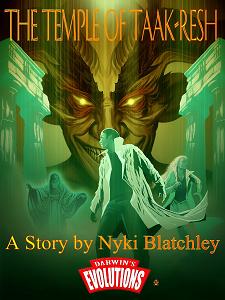
story is set in the same world as my previous Musa publication, The Treason of Memory (as well as many other stories, including my StoneGarden novel At An Uncertain Hour and my Darwin's Evolutions ebook The Temple of Taak-Resh) but in a different type of setting from those.
The two last, like a number
of others, are set in what could loosely be called a standard setting for epic
fantasy or sword & sorcery.
Hopefully not in a clichéd way — I try to portray a range of different
types of pre-gunpowder civilisations, rather than the usual bland blend of
something that vaguely passes for a cross between mediaeval Europe and ancient
Babylon — but the stories have broadswords, horses, temples to numerous gods
and so on.
The Treason of Memory, on the other hand, is set in a culture of
flintlocks and rapiers, somewhat reminiscent of Europe in the late 17th/early
18th centuries, while The Lone and Level Sands has more in common with
the mid 20th century. This is a long
way from broadswords, or even flintlocks, although perhaps not exactly like the
equivalent period in the real world: land vehicles are mainly electric, for
instance, and air travel comes courtesy of airships.
The Lone and Level Sands is archaeological fantasy. Like parts of the Indiana Jones series, it's set in a desert
country in an unstable world where anything could happen. It has elements of a thriller — sinister
rivals, trigger-happy soldiers, blackmail and betrayal — as well as the fantasy
elements of a temple out of mythology and... well, you'll have to read the
story, when it comes out.
Coincidentally, I have
another story coming out later this year, in the excellent magazine Aoife's
Kiss, which is related to this, to the extent that it's also a view of the same
myth from a "modern" world.
This time, though, the culture is the computer age of the same world. If you pay attention, you'll find a couple of
more specific links between the two.
So what's the advantage of
doing it this way? Wouldn't it be
simpler to create a world for each story, or at least each series? A pre-gunpowder world, a world of
flintlocks, and so on? Just invent what
I need, when I need it?
Well, it would be easier in
some ways, but I think nowhere near as effective. In a joined-up world, the ideas don't come in isolation, and they
don't develop in isolation, either. The
legend behind The Lone and Level Sands is (hopefully) effective because
it's a story I already knew, and the "modern" discovery has a history
that make it comparable to finding a relic from Atlantis in our world.
The background to these
stories isn't just a background — it's people and places whose stories I know
and have written about. That's a level
of reality that's difficult to achieve in a one-story world. Not impossible, but difficult.
The world I use offers me
the means to write almost any kind of story I want, from epic fantasy to occult
thriller — I've even found a corner to write something resembling steampunk —
and stories come into being from the influence of their own past and
future. There are stories coming to me
that need to belong to a different world, whether it's a one-off or an ongoing
world, but I don't anticipate running out of fascination and inspiration in my
flexible world anytime soon. Probably
never.
Subscribe to:
Posts (Atom)